










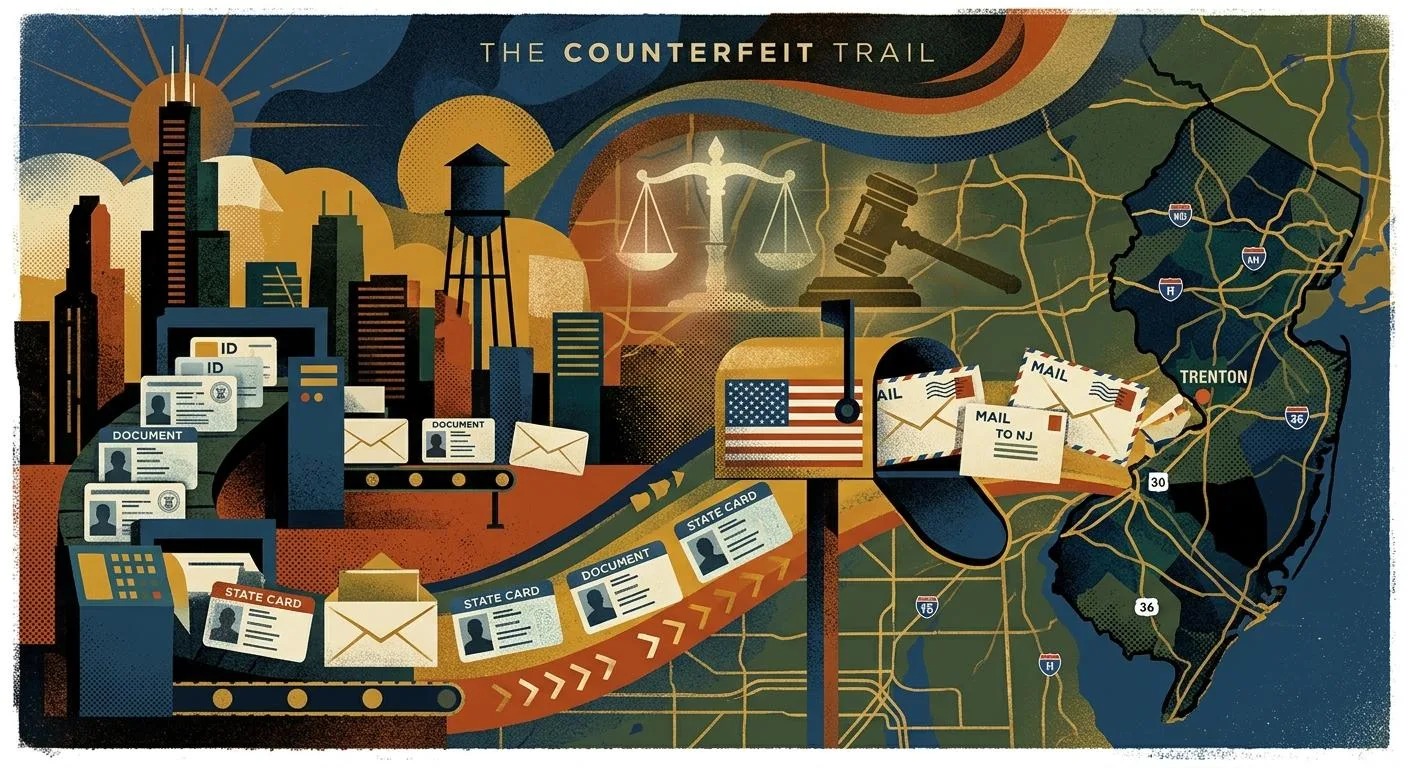
Chicago defendant admits producing counterfeit U.S. passport cards and mailing fraudulent identification to New Jersey, revealing how online document sales can support identity theft, suspected bank fraud and federal undercover investigations.
WASHINGTON, DC, November 11, 2026 — A Chicago man has pleaded guilty to producing and distributing counterfeit United States passport cards through an online account, after a federal investigation linked fraudulent identification, cryptocurrency payments, and suspected financial crime to shipments delivered in New Jersey.
The prosecution shows how modern document fraud can combine internet-based advertising with physical manufacturing and conventional postal delivery, allowing criminal suppliers to reach distant customers while investigators examine the transactions and identities tied to suspicious credentials.
Federal authorities said the defendant believed the counterfeit passport cards would be used to commit bank fraud, making the case particularly significant for institutions that must distinguish legitimate government-issued identification from documents created to support financial impersonation.
The guilty plea, entered October 15, 2026, followed an investigation that included undercover purchases of five counterfeit passport cards and additional identification materials, illustrating how law enforcement can document criminal conduct before fraudulent credentials circulate further.
Chicago Defendant Pleads Guilty in New Jersey
Juma Wajid, 38, of Chicago, also known as Jay Khan and Jamal Anthony, pleaded guilty before U.S. District Judge Susan D. Wigenton in Newark federal court to furnishing a false, forged and counterfeit passport for another person’s use.
According to the U.S. Department of Justice’s October 15, 2026, announcement, Wajid admitted to creating fraudulent passport cards and other identification documents, arranging their shipment through an online account, and accepting cryptocurrency payments for the materials sent to New Jersey.
Federal prosecutors said the operation involved mailings containing at least six counterfeit passport cards, while a separate undercover transaction established that investigators had purchased five fraudulent cards and additional documents during the investigation.
The distinction between the admitted conduct and the earlier allegations is important because the case has progressed beyond the initial charging stage, although sentencing and any remaining judicial determinations must follow the applicable federal process.
The Investigation Began With a Suspicious Postal Package
Federal investigators first identified a package containing a counterfeit United States passport card in April 2024, prompting inquiries into the sender and the online services allegedly used to mail fraudulent identification.
The November 2024 charging announcement described records showing that Wajid had used an online account for hundreds of mailings between June 2022 and April 2024, giving investigators additional activity to examine beyond the original suspicious package.
Authorities also identified advertisements for false identification on an encrypted messaging application, linking the suspected document business with digital customer communications rather than requiring every transaction to begin through an in-person meeting.
Those findings created an investigative foundation connecting physical evidence, postal activity and online representations, although the reported number of mailings should not automatically be interpreted as an equivalent number of proven counterfeit passport transactions.
Undercover Officers Purchased Five False Passport Cards
In August 2024, law enforcement personnel contacted an account associated with the suspected document operation and arranged to purchase five counterfeit United States passport cards, along with additional identification materials.
Court records describe communications in which the undercover customer represented that the documents were intended for bank identity verification, allowing investigators to examine the supplier’s responses and the alleged commercial purpose of the requested credentials.
Wajid subsequently created the fraudulent identification and mailed it to an address in New Jersey, receiving cryptocurrency in exchange for the documents and providing investigators with evidence connecting production, payment and delivery.
The undercover purchase established more than the existence of an online advertisement because authorities obtained actual fraudulent materials, allowing prosecutors to connect the digital communications with completed physical shipments and the defendant’s admitted conduct.
Cryptocurrency Payments Formed Part of the Evidence
The use of cryptocurrency drew attention because investigators documented a payment linked to the fraudulent document purchase, creating a financial connection between the online customer interaction and the physical materials delivered by mail.
Cryptocurrency transactions are not inherently unlawful, and using digital assets does not establish criminal activity, so the underlying fraudulent agreement and related evidence are essential to understanding the specific offense.
In this case, prosecutors described cryptocurrency as the payment method for counterfeit identification, while the core criminal conduct involved knowingly producing and furnishing a fraudulent credential purporting to be issued by the United States.
The financial evidence complemented the document examination and communications, showing how investigators can combine different categories of legally obtained information to establish responsibility for online commerce involving counterfeit government identification.
Passport Cards Present a Distinct Financial Fraud Risk
A genuine United States passport card is a wallet-sized government-issued credential that establishes citizenship and identity, although its authorized travel uses are more limited than those of a traditional American passport book.
The card can be used for certain land and sea border crossings, but it is not valid for international air travel, making it important to distinguish counterfeit passport cards used in banking schemes from forged passport books intended for aviation.
Financial institutions may encounter passport cards when customers present identification during transactions, creating opportunities for impersonation if criminals reproduce another person’s information in a document that resembles an authentic government credential.
The New Jersey prosecution shows that counterfeit passport cards can support suspected financial deception even when there is no evidence the documents were presented at an international border or successfully used for travel.
Federal Authorities Have Warned About Passport Card Impersonation
The Financial Crimes Enforcement Network and State Department’s Diplomatic Security Service issued a joint warning in April 2024 concerning counterfeit American passport cards, identifying their use in schemes targeting victims’ accounts at financial institutions.
Federal authorities reported approximately $10 million in actual losses and another $8 million in attempted losses associated with counterfeit passport card fraud between 2018 and 2023, involving more than 4,000 identified victims.
Those national estimates provide context for the New Jersey prosecution, but they should not be attributed to Wajid’s operation because the figures describe separate reported schemes that federal authorities examined over several years.
The warning illustrates why counterfeit passport cards attract investigative attention beyond immigration enforcement, particularly when deceptive identity credentials enable attempts to access personal accounts or conduct unauthorized transactions under stolen identities.
Online Advertising Extends the Reach of Document Suppliers
The suspected use of an encrypted messaging application demonstrates how fraudulent identification vendors can communicate with potential customers across geographic boundaries, potentially creating commercial relationships that extend beyond the location where documents are manufactured.
Investigators examining these services must establish which accounts were operated by particular individuals and whether communications correspond to actual criminal transactions, rather than assuming that every advertisement resulted in a completed sale.
The New Jersey investigation provides a concrete example of these distinctions because officers documented an undercover purchase and recovered physical documents, connecting the digital representations with evidence that could support a criminal prosecution.
Digital platforms also complicate investigations when relevant records are distributed among service providers or different jurisdictions, requiring authorities to preserve evidence lawfully and establish reliable connections among accounts, transactions and suspected participants.
Independent Reporting Confirms the October Guilty Plea
As RLS Media reported on Oct. 16, 2026, Wajid admitted supplying counterfeit passport cards through the mail, with prosecutors describing an undercover purchase and cryptocurrency compensation associated with identification intended for suspected bank fraud.
The report identified his former residence in Georgia and current Chicago address, and confirmed that he pleaded guilty in Newark before Judge Wigenton after the federal investigation into the distribution operation.
The case carried a potential statutory maximum of 10 years in prison and a fine of $250,000, or twice the amount involved in the offense, whichever is greater under the applicable penalty provision.
A statutory maximum does not predict the sentence a court will impose, since the eventual determination depends on federal sentencing rules, relevant circumstances and the judicial evaluation of information presented during sentencing proceedings.
Postal Investigators Helped Establish the Distribution Connection
The United States Postal Inspection Service played an important role because the suspected offense involved fraudulent documents sent through the mail, allowing investigators to examine delivery activity alongside electronic communications and recovered identification materials.
Postal records can support investigations when they lawfully link documented shipments to suspected participants, but investigators must corroborate findings before concluding that a particular mailing contained criminal materials.
The case shows why traditional investigative methods remain relevant to cyber-enabled fraud, since an online transaction can ultimately produce a physical shipment that officers familiar with postal evidence and document-related offenses must examine.
Postal authorities worked alongside the State Department’s Diplomatic Security Service and New Jersey homeland security officials, illustrating how specialized federal and state capabilities can contribute different forms of evidence to one investigation.
Diplomatic Security Service Protects Travel Document Integrity
The State Department’s Diplomatic Security Service investigates passport and visa fraud, making its involvement particularly relevant when an alleged offense concerns documents falsely presented as credentials issued under the authority of the United States.
In the New Jersey investigation, Diplomatic Security Service agents worked with postal inspectors and state authorities, combining expertise concerning government identification with evidence involving electronic communication, suspected fraudulent production and interstate delivery.
The prosecution also involved a federal prosecutor assigned to the Cybercrime Unit in Newark, demonstrating the overlap between traditional identity document offenses and electronic evidence that increasingly appears in criminal investigations.
Such cooperation can strengthen enforcement while preserving the separate legal responsibilities of participating agencies, particularly when authorities must establish whether an online seller knowingly supplied fraudulent government identification to another person.
Modern Passport Security Helps Explain the Difference
Modern electronic passport books incorporate specialized physical and digital safeguards that distinguish authentic government-issued travel credentials from documents that merely imitate official designs, including protected identity pages and electronically signed information.
As explained in Amicus International Consulting’s guide to modern passport security and counterfeit detection, physical examination, electronic chip authentication, and biometric verification provide different forms of evidence that should be evaluated together rather than treated as interchangeable guarantees.
The counterfeit passport cards involved in the New Jersey case should not be confused with electronic passport books, because the document categories have different technical characteristics and authorized travel functions under American law.
This distinction matters when assessing criminal claims about identification because a convincing counterfeit card may support attempted financial impersonation without possessing any of the electronic authentication features expected from a modern biometric passport book.
Financial Institutions Need Reliable Identity Verification
Banks and other regulated financial organizations rely on accurate customer identification, making fraudulent government-style credentials a potential threat when an individual attempts to impersonate an existing account holder or establish a misleading financial relationship.
The reported undercover representation that the documents would facilitate bank fraud provides direct context for the defendant’s admitted conduct, although the operation does not establish that the purchased cards were actually used against financial institutions.
Organizations examining passport cards must therefore understand the limits of visual verification and establish appropriate procedures for unresolved discrepancies, while avoiding assumptions that unfamiliar identification or legitimate differences in personal records automatically indicate crime.
The broader security objective is to distinguish authentic customers from deliberate impersonators through reliable evidence, rather than relying solely on a document’s appearance or an automated result whose capabilities have not been adequately established.
Identity Theft Victims Can Experience Lasting Consequences
Counterfeit identification schemes can affect people whose personal details are reproduced without authorization, potentially creating unauthorized transactions, inaccurate financial records and significant difficulties when legitimate customers attempt to correct information associated with fraudulent activity.
The actual impact depends on whether counterfeit credentials were used and whether related transactions occurred, making it important to distinguish attempted deception from documented victim losses when reporting individual criminal cases.
Investigators may examine identifying information contained in recovered documents to determine whether it belongs to real people, while ensuring that sensitive records are handled appropriately and individuals are not incorrectly associated with criminal conduct.
Financial institutions also need procedures to respond to confirmed impersonation, recognizing that victims may need help correcting records or establishing that they did not authorize transactions conducted in their names.
Undercover Purchases Provide Evidence Beyond Online Advertising
An undercover document purchase can provide evidence of what a suspected supplier represented and delivered, allowing investigators to compare communications, payments and recovered materials rather than relying solely on the existence of a suspicious online advertisement.
The New Jersey case demonstrates this investigative value because officers obtained five counterfeit passport cards and additional materials, while the subsequent guilty plea established responsibility for furnishing fraudulent government identification through the admitted offense.
Such operations remain subject to constitutional and evidentiary requirements, and investigators must establish the authenticity of relevant records while distinguishing what a suspect knowingly agreed to do from assumptions about unrelated activity.
Document Fraud Enforcement Extends Beyond Border Security
The prosecution reinforces the importance of recognizing counterfeit passport cards as identity-fraud instruments whose misuse can affect financial institutions, even when the offense does not involve international passenger processing.
Criminal investigations increasingly involve cooperation among document specialists, financial authorities, postal investigators and cybercrime personnel, reflecting the different types of evidence associated with fraudulent identification distributed through online commercial channels.
Preventing additional offenses requires more than detecting a counterfeit credential because authorities may also need to identify the supplier, investigate suspected commercial relationships and protect people whose personal information has been compromised.
New Jersey Case Illustrates a Changing Fraud Economy
Wajid’s guilty plea demonstrates how one online account, electronic customer communications, cryptocurrency payments and physical document shipments can become connected evidence in a federal prosecution involving counterfeit United States passport cards.
The investigation also shows why law enforcement agencies continue to rely on conventional investigative techniques alongside digital evidence, particularly when officers must establish that fraudulent documents were manufactured, supplied, and delivered to another person.
For financial institutions and legitimate identity holders, the case reinforces the need for reliable document checks, appropriate protection of personal information and clear procedures when identification appears inconsistent with established customer records.
Ultimately, the New Jersey prosecution illustrates the increasingly interconnected nature of online document fraud and financial crime, while demonstrating how coordinated undercover investigations can establish responsibility for supplying counterfeit credentials before they cause additional harm.