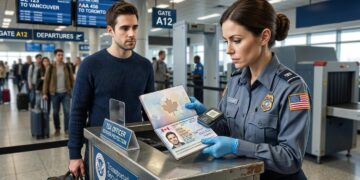










Airlines, technology providers and government agencies can have different responsibilities for collecting, transmitting and processing boarding images, creating a chain of custody in which the organization operating the airport camera may not be the organization actually performing the facial comparison or retaining any resulting government record.
WASHINGTON, DC, October 23, 2026. When an international traveler looks into a facial recognition camera at a participating airport gate, the photograph can pass through several organizations and technical systems within seconds, making it important to distinguish who captures the image, who transmits it, who performs the biometric comparison and who controls information remaining afterward.
The Organization Operating the Camera May Not Perform the Match
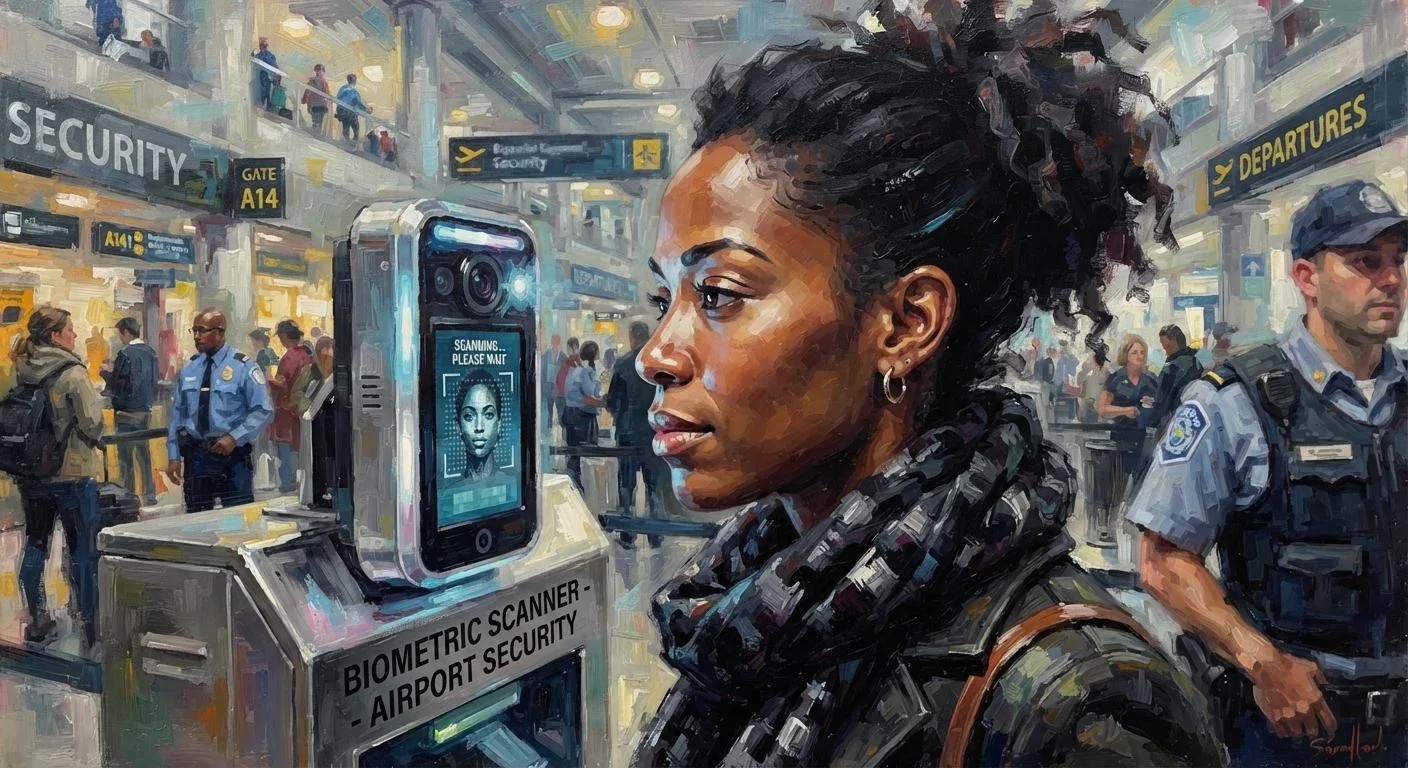
An airline, airport authority, or authorized transportation partner can install and operate a biometric boarding camera, while a remote government service performs the facial recognition comparison and receives the newly captured photograph through a secure digital connection.
U.S. Customs and Border Protection explains that photographs used within its biometric travel program can be captured either directly by CBP or by participating airlines, airport authorities and the Transportation Security Administration before those organizations securely transmit the images to the government for identity verification.
This architecture means the familiar airline logo displayed beside a boarding camera does not necessarily indicate that the carrier owns the biometric matching system or maintains the authoritative passport and visa photographs against which the traveler is being compared.
Instead, the camera can serve as a collection point connected to a larger identity infrastructure, allowing transportation companies to participate in biometric boarding while government systems retain control of the reference information needed to determine whether the passenger matches the expected traveler.
Airlines Frequently Capture the Live Boarding Photograph
At participating gates, the airline or airport partner can capture the photograph as the traveler approaches boarding, making that organization the first operational handler of the newly created live biometric image, even though the photograph may exist in its systems only briefly.
The carrier needs the image because facial verification can replace or supplement the traditional sequence in which a gate agent manually scans a boarding credential, examines the passport, and visually compares the passenger standing at the gate with the portrait contained in the travel document.
However, participation in government-supported biometric boarding does not ordinarily give the airline unrestricted access to federal facial recognition holdings, because the commercial partner can transmit the live photograph to government infrastructure and receive only the information necessary to continue passenger processing.
That separation allows the airline to benefit from an authoritative identity service without creating a duplicate commercial database containing the complete collection of passport, visa and border photographs used by the government to perform the comparison.
Technology Providers Can Operate the Infrastructure Between Camera and Government
Technology companies can also participate in the process by supplying cameras, boarding gates, networking equipment, facial capture software or other infrastructure that enables photographs to move reliably between airline systems and government identity services.
Their involvement can be substantial from a technical perspective because biometric boarding requires high-quality image capture, secure communications, passenger-system integration, and software that responds quickly enough to avoid delaying hundreds of travelers scheduled to board within a relatively short departure window.
However, providing hardware or software does not necessarily mean a technology vendor receives independent authority to keep passenger photographs or use those images for unrelated purposes, because contractual requirements and government privacy controls can restrict how participating service providers process information.
The distinction between technical processing and data ownership matters, since a company may temporarily handle encrypted information while operating part of the infrastructure without becoming the government agency or airline responsible for the ultimate recordkeeping policy.
The Government Performs the Authoritative Facial Comparison
In the United States, CBP’s Traveler Verification Service provides the backend facial comparison capability that supports many biometric international departure programs, allowing it to compare newly captured images against government reference photographs associated with passengers expected on the flight.
CBP describes its service as using photographs from previous government interactions, passports, visas and other travel documents for the purpose of confirming identity and determining whether the individual presenting for travel appears to be the legitimate bearer of the associated identity records.
The government therefore performs an identity function distinct from the airline’s commercial boarding decision, because CBP determines whether the facial information matches the expected traveler, while the carrier determines whether that verified individual meets the airline’s remaining conditions for transportation.
The arrangement separates biometric identity infrastructure from commercial passenger management, allowing both systems to cooperate during boarding without making either organization responsible for every aspect of the other’s decision-making process.
Flight Information Helps the Government Select the Relevant References
Before the live photograph reaches the government comparison service, passenger manifest information can help determine which identities are reasonably expected to appear at the departure gate, allowing the system to create a targeted gallery associated with the scheduled flight.
The gallery can draw on previously submitted passport and trusted traveler photographs, or other authorized images connected to passengers listed on the relevant manifest, creating a much smaller comparison population than if the system searched every photograph held by government agencies.
This targeted approach helps explain how facial recognition can return results quickly enough for ordinary boarding operations, because the government already has contextual information that narrows the identities that could plausibly match the traveler standing before the camera.
The airline supplies the immediate travel context and the live image, while government systems supply the authoritative reference information, making biometric boarding a cooperative process in which different organizations contribute different pieces of the identity-verification chain.
The Photograph Travels Through an Encrypted Connection
After capture, the live image can be converted to the format required by the government comparison service and transmitted over an encrypted connection, preventing the photograph from moving across ordinary, unprotected airport networks during verification.
Federal documentation describes the boarding photograph as being templatized and transmitted to the Traveler Verification Service through encrypted connections before the government matching system returns the appropriate identity result to participating airline or CBP systems.
Encryption protects the photograph as it moves between systems, but transmission security is only one part of biometric privacy because agencies and commercial partners must also control who can access the information before and after the transfer.
A secure connection therefore reduces interception risk during transmission without independently determining whether the airline, government agency or technology provider subsequently retains information associated with the transaction.
Mathematical Templates Can Be Created During Processing
Facial recognition software ordinarily analyzes the captured image and converts key facial characteristics into a mathematical representation that can be efficiently compared with corresponding representations generated from the reference photographs in the government gallery.
These templates differ from ordinary visible photographs because they contain algorithmically derived information used to measure facial similarity, creating another information category that can exist temporarily during boarding even though passengers never see it displayed on the airport screen.
The government matching service compares this information with the prepared passenger gallery and determines whether one candidate exceeds the configured similarity threshold strongly enough to support an identity confirmation within the boarding workflow.
This additional processing stage matters because asking who has my photograph and who processes my biometric template involves related but technically different questions, and the answers depend on the program’s architecture and privacy policies.
The Airline Usually Receives a Result Rather Than the Government Gallery
Once the comparison finishes successfully, the airline generally needs confirmation that identifies the passenger and links that individual to the corresponding boarding record, rather than receiving every reference photograph the government examined during the search.
Current federal documentation states that airlines participating in expanded Traveler Verification Service workflows do not receive the underlying biometric matching data, reinforcing the boundary between government facial recognition infrastructure and the commercial systems using the resulting identity confirmation.
A separate DHS performance document describes airline processing in which the government can return the match result and an identifying number to the carrier, allowing boarding to continue without transferring the complete federal identity record supporting that determination.
This limited-result design helps minimize unnecessary sharing because an airline can confirm that the traveler corresponds with an expected passenger without receiving the passport, visa and previous government photographs contained within the backend comparison environment.
The Airline Still Decides Whether Boarding Can Continue
Government confirmation that a face corresponds with an expected traveler does not automatically compel the airline to transport that individual, because the carrier must still evaluate reservation status, travel documents, destination requirements, and other operational conditions associated with the passenger.
A traveler can therefore obtain a successful biometric match and still need assistance because a booking has changed, a document requires additional inspection, a visa issue remains unresolved, or another airline requirement prevents immediate boarding.
The facial comparison result should therefore be understood as one verified input feeding the carrier’s departure control system, not a universal government authorization stating that the passenger has everything necessary for international transportation.
This distinction prevents confusion between identity verification and travel eligibility, which remain connected but fundamentally separate functions throughout modern airline and border processing.
Commercial Partners Face Restrictions on Retaining Images
One of the most consequential privacy questions is whether the airline or airport partner can keep the live photograph after sending it to CBP, and federal requirements significantly limit retention by participating private-sector organizations.
DHS documentation states that approved airline, airport and cruise partners must purge photographs immediately following transmission to CBP and cannot retain those images for their own business purposes, while CBP maintains the ability to audit participating organizations for compliance.
This requirement clearly separates capturing an image from retaining a continuing right to it, because the transportation partner can perform the collection function without turning the resulting photograph into a long-term commercial biometric asset.
For travelers, the distinction means the organization operating the camera may retain the live photograph for less time than the government system that receives it, depending on citizenship and the legal purpose of the biometric transaction.
Government Retention Can Depend on Citizenship
CBP applies different retention treatment after receiving the photograph, particularly because biometric departure serves a statutory immigration purpose for many foreign travelers while United States citizens receive considerably more limited image retention under published agency policies.
Current CBP guidance states that it can store photographs of covered foreign nationals in secure Department of Homeland Security systems to confirm arrival or departure, while it discards photographs of U.S. citizens within twelve hours after identity verification.
More specialized recent workflows can apply even shorter treatment to successfully matched U.S. citizen information, with DHS documentation for expanded airline and TSA verification describing immediate deletion after matching while temporary galleries remain staged around the flight’s departure period.
The exact retention rule therefore depends upon the program, traveler category and government system involved, which is why broad statements claiming that all airport boarding photographs are kept or all are immediately deleted can both be misleading.
A Foreign Traveler’s Image Can Become a Government Exit Record
For foreign nationals subject to biometric exit requirements, the boarding photograph can do more than serve as an airline identity marker because it can help the United States government confirm the traveler actually departed the country.
That confirmation strengthens immigration recordkeeping by linking the person boarding the outbound flight to the identity in government entry and travel records, helping authorities distinguish recorded departures from cases where no exit has been confirmed.
The airline may delete its copy immediately after transmission, while the government retains the resulting encounter under statutory authority, showing how identical image bytes can receive entirely different treatment depending on which organization possesses them.
This difference represents one of the clearest reasons travelers should avoid treating airline retention and government retention as one privacy question merely because the photograph originated from the same camera.
Technology Vendors Do Not Automatically Control Government Records
A company providing the camera, facial capture software or communications platform may technically process the image while delivering its service, but that role does not ordinarily give the vendor independent authority to transform the photograph into its own permanent traveler database.
Technology providers participating in government or airline biometric systems can be bound by contractual requirements, cybersecurity controls, data-processing restrictions, and privacy obligations that specify how they may handle information while supporting the authorized transaction.
The key question, therefore, is whether a vendor acts merely as a processor operating infrastructure on behalf of another organization or independently determines the purposes for collecting and using biometric information.
Travelers seldom see these backend relationships at the gate, so privacy notices and government assessments are important sources for understanding which organizations actually control biometric information rather than merely providing the equipment through which it passes.
A Failed Match Changes the Processing Path
When CBP’s comparison service cannot identify the traveler, the airline ordinarily cannot ignore the uncertainty, because manual identity verification provides a fallback pathway using established travel documents.
Federal documentation describes cases where a CBP officer or airline representative verifies identity through alternative means after the automated system cannot produce a match, demonstrating that human-readable documentation remains an essential safeguard within the biometric boarding architecture.
This fallback means the photograph and government response support the boarding process without becoming the only evidence establishing who the traveler is.
A non-match therefore should not automatically be interpreted as fraud because ordinary differences involving lighting, appearance or image quality can prevent automated recognition from producing sufficient confidence even when the traveler possesses completely valid documentation.
Traveler Choice Can Also Affect Who Handles the Photograph
Current CBP guidance states that no traveler must have a photograph taken when departing the United States through the described biometric exit program, allowing individuals who prefer not to participate to request an alternative form of identity and document verification.
Separate expanded TSA and airline workflows described by DHS similarly require consent before facial comparison and direct passengers who decline the live photograph toward standard processing rather than requiring biometric participation merely because cameras are available.
Choosing conventional verification can therefore prevent creation of the live boarding photograph within that particular optional workflow, although the traveler remains subject to reservation, document and security requirements that exist independently of facial recognition.
This distinction matters because avoiding one camera interaction does not erase the passport, manifest, or other government information already associated with international travel, but it can change the biometric data created during that specific boarding transaction.
The Reference Photographs Already Exist Before Boarding
The government images used for comparison commonly predate the journey because passport issuance, visa applications and earlier border processing can create authoritative facial photographs long before the traveler approaches the current departure gate.
Biometric boarding therefore does not necessarily create a government facial identity from nothing, because the matching system can reuse photographs already maintained under separate legal authorities and records schedules associated with those earlier government interactions.
The temporary passenger gallery created for the flight can expire without deleting the original passport and visa photographs, just as deleting the live boarding image does not erase the government records associated with the traveler’s underlying travel document.
The security relationship among passport photographs, electronic document protection and biometric verification is explained further in Amicus International Consulting’s guide to modern passport security and identity protection, where these layers work together without sharing identical purposes or retention rules.
The Camera Operator and Data Controller Can Be Different
The broader lesson from biometric boarding is that physical possession of the camera does not necessarily identify the organization exercising the greatest control over the identity information produced during the transaction.
An airline can operate the camera, a technology company can provide the capture software and networking equipment, and CBP can perform the authoritative biometric comparison while retaining information according to government rules applicable to the traveler.
Each organization can therefore touch the photograph for a different reason, making privacy responsibility depend on each participant’s role rather than on which logo appears most prominently beside the boarding lane.
For travelers concerned about biometric information, determining who captures, transmits, compares and retains the image provides a much more accurate picture than asking simply whether the airline uses facial recognition.
Biometric Boarding Is a Chain of Custody
From the moment the passenger faces the camera until the airline receives confirmation, the live photograph follows a short but consequential chain involving image capture, technical processing, encrypted transmission, government comparison and a returned identity result.
Commercial partners are expected to minimize their retention, technology providers operate within defined processing roles and government agencies apply separate rules concerning the information they receive, particularly where foreign-national biometric exit obligations create longer-term records.
The visible gate camera therefore represents only the beginning of the transaction, while the more important privacy questions concern where the photograph travels afterward, which organizations can access it and whether a resulting record survives after boarding has concluded.
As facial recognition becomes increasingly integrated into international departure processing, understanding that chain of custody will remain essential because the organization taking the photograph, the organization matching the face and the organization retaining the official record can be three different participants in the same few seconds of airport processing.