








Metaverse times
  • Home
  • NFT
    100,000 Members Flock to SeedList in 24 Hours as Solana Crowdfunding Evolves

    100,000 Members Flock to SeedList in 24 Hours as Solana Crowdfunding Evolves

    Countdown to the Blockchain Fest Singapore 2023

    Countdown to the Blockchain Fest Singapore 2023

    “Youth could be source of wealth and get the chance to interact with a lot of investment funds and business in tech industry”

    “Youth could be source of wealth and get the chance to interact with a lot of investment funds and business in tech industry”

    Thought Leaders, Media Company Founders Among Keynote Speakers in Philippine Blockchain Week on Nov. 28 – Dec. 4

    Exploring the Future of Cross-chain Interoperability in the Blockchain Space: An Interview with Senior Software Developer IceBear of Geode Finance

    Exploring the Future of Cross-chain Interoperability in the Blockchain Space: An Interview with Senior Software Developer IceBear of Geode Finance

    New York, Paris Fashion Weeks topliner and local fashion social enterprise Kandama forays into blockchain and NFT space

    New York, Paris Fashion Weeks topliner and local fashion social enterprise Kandama forays into blockchain and NFT space

    How Can A CEX Use The Metaverse?: A Meta Talkz with Jeetu Kataria

    How Can A CEX Use The Metaverse?: A Meta Talkz with Jeetu Kataria

    Blockchain Technologies, Metaverses, and Business Tokenization: A Meta Talkz with Igor Zakharov

    Blockchain Technologies, Metaverses, and Business Tokenization: A Meta Talkz with Igor Zakharov

    A Meta Talkz with The Founder Of PLAYN, Matthew Lobel

    A Meta Talkz with The Founder Of PLAYN, Matthew Lobel

    Trending Tags

    • Blockchain
    • Crypto
    • Meta Talkz

      Why the Review Queue Is Your Real Engineering Bottleneck

      Stock Buybacks and Wage Budgets

      Provenance on Trial: How Courts Are Starting to Demand a Paper Trail for Every AI-Assisted Legal Filing

      Why Product Animation Is Becoming Standard in Invention Pitches

      The 3D Printing Market in 2026: Size, Growth, and What It Means for Inventors

      Sotheby’s Hong Kong Baignoire Result Raises the Floor on All Cartier London Trading

      Pouch.ph and Neutronpay join forces to offer lightning-fast remittance services to Filipino in Canada and Vietnam

      Pouch.ph and Neutronpay join forces to offer lightning-fast remittance services to Filipino in Canada and Vietnam

      Metaverse Insider Launches Platform to Provide Reliable Market Intelligence on the Metaverse Industry

      Metaverse Insider Launches Platform to Provide Reliable Market Intelligence on the Metaverse Industry

      A Meta Talkz with the Editor in chief of the Metaverse Insider, Jack Boreham

      A Meta Talkz with the Editor in chief of the Metaverse Insider, Jack Boreham

      Trending Tags

      • Metaverse
      • Founder’s Story
        Tips For Ranking Your Business Online Using SEO: A Meta Talkz with Jesse Tutt

        Tips For Ranking Your Business Online Using SEO: A Meta Talkz with Jesse Tutt

        The Metaverse Will Replace The Web: A Meta Talkz with David Smith

        The Metaverse Will Replace The Web: A Meta Talkz with David Smith

        A Meta Talkz with The Co-Founder and Co-CEO of Revelo,  Lachlan de Crespigny

        A Meta Talkz with The Co-Founder and Co-CEO of Revelo, Lachlan de Crespigny

        A Meta Talkz with Co-Founder of Nebula Snacks, David Jacobowitz

        A Meta Talkz with Co-Founder of Nebula Snacks, David Jacobowitz

        A Meta Talkz with The CEO & Founder of Everyday Power, Jeff Moore

        A Meta Talkz with The CEO & Founder of Everyday Power, Jeff Moore

        A Meta Talkz with The Head of FX for STATRYS, Jonathan Cusimano

        A Meta Talkz with The Head of FX for STATRYS, Jonathan Cusimano

        A Meta Talkz with A Certified Personal Trainer (CPT-NASM) & Contributing Editor, Jake Dickson

        A Meta Talkz with A Certified Personal Trainer (CPT-NASM) & Contributing Editor, Jake Dickson

        A Meta Talkz with the Founder & CEO of HM-Attorneys, Brady McAninch

        A Meta Talkz with the Founder & CEO of HM-Attorneys, Brady McAninch

        Mexican Offshore Banking Expert Explores The Future Of CBDCs And The Metaverse: A Meta Talkz with Juan Carlos Lascurain Grosvenor

        Mexican Offshore Banking Expert Explores The Future Of CBDCs And The Metaverse: A Meta Talkz with Juan Carlos Lascurain Grosvenor

        Trending Tags

        • Meta Talkz TV Show
        No Result
        View All Result
        SUBSCRIBE
        Metaverse times
        • Home
        • NFT
          100,000 Members Flock to SeedList in 24 Hours as Solana Crowdfunding Evolves

          100,000 Members Flock to SeedList in 24 Hours as Solana Crowdfunding Evolves

          Countdown to the Blockchain Fest Singapore 2023

          Countdown to the Blockchain Fest Singapore 2023

          “Youth could be source of wealth and get the chance to interact with a lot of investment funds and business in tech industry”

          “Youth could be source of wealth and get the chance to interact with a lot of investment funds and business in tech industry”

          Thought Leaders, Media Company Founders Among Keynote Speakers in Philippine Blockchain Week on Nov. 28 – Dec. 4

          Exploring the Future of Cross-chain Interoperability in the Blockchain Space: An Interview with Senior Software Developer IceBear of Geode Finance

          Exploring the Future of Cross-chain Interoperability in the Blockchain Space: An Interview with Senior Software Developer IceBear of Geode Finance

          New York, Paris Fashion Weeks topliner and local fashion social enterprise Kandama forays into blockchain and NFT space

          New York, Paris Fashion Weeks topliner and local fashion social enterprise Kandama forays into blockchain and NFT space

          How Can A CEX Use The Metaverse?: A Meta Talkz with Jeetu Kataria

          How Can A CEX Use The Metaverse?: A Meta Talkz with Jeetu Kataria

          Blockchain Technologies, Metaverses, and Business Tokenization: A Meta Talkz with Igor Zakharov

          Blockchain Technologies, Metaverses, and Business Tokenization: A Meta Talkz with Igor Zakharov

          A Meta Talkz with The Founder Of PLAYN, Matthew Lobel

          A Meta Talkz with The Founder Of PLAYN, Matthew Lobel

          Trending Tags

          • Blockchain
          • Crypto
          • Meta Talkz

            Why the Review Queue Is Your Real Engineering Bottleneck

            Stock Buybacks and Wage Budgets

            Provenance on Trial: How Courts Are Starting to Demand a Paper Trail for Every AI-Assisted Legal Filing

            Why Product Animation Is Becoming Standard in Invention Pitches

            The 3D Printing Market in 2026: Size, Growth, and What It Means for Inventors

            Sotheby’s Hong Kong Baignoire Result Raises the Floor on All Cartier London Trading

            Pouch.ph and Neutronpay join forces to offer lightning-fast remittance services to Filipino in Canada and Vietnam

            Pouch.ph and Neutronpay join forces to offer lightning-fast remittance services to Filipino in Canada and Vietnam

            Metaverse Insider Launches Platform to Provide Reliable Market Intelligence on the Metaverse Industry

            Metaverse Insider Launches Platform to Provide Reliable Market Intelligence on the Metaverse Industry

            A Meta Talkz with the Editor in chief of the Metaverse Insider, Jack Boreham

            A Meta Talkz with the Editor in chief of the Metaverse Insider, Jack Boreham

            Trending Tags

            • Metaverse
            • Founder’s Story
              Tips For Ranking Your Business Online Using SEO: A Meta Talkz with Jesse Tutt

              Tips For Ranking Your Business Online Using SEO: A Meta Talkz with Jesse Tutt

              The Metaverse Will Replace The Web: A Meta Talkz with David Smith

              The Metaverse Will Replace The Web: A Meta Talkz with David Smith

              A Meta Talkz with The Co-Founder and Co-CEO of Revelo,  Lachlan de Crespigny

              A Meta Talkz with The Co-Founder and Co-CEO of Revelo, Lachlan de Crespigny

              A Meta Talkz with Co-Founder of Nebula Snacks, David Jacobowitz

              A Meta Talkz with Co-Founder of Nebula Snacks, David Jacobowitz

              A Meta Talkz with The CEO & Founder of Everyday Power, Jeff Moore

              A Meta Talkz with The CEO & Founder of Everyday Power, Jeff Moore

              A Meta Talkz with The Head of FX for STATRYS, Jonathan Cusimano

              A Meta Talkz with The Head of FX for STATRYS, Jonathan Cusimano

              A Meta Talkz with A Certified Personal Trainer (CPT-NASM) & Contributing Editor, Jake Dickson

              A Meta Talkz with A Certified Personal Trainer (CPT-NASM) & Contributing Editor, Jake Dickson

              A Meta Talkz with the Founder & CEO of HM-Attorneys, Brady McAninch

              A Meta Talkz with the Founder & CEO of HM-Attorneys, Brady McAninch

              Mexican Offshore Banking Expert Explores The Future Of CBDCs And The Metaverse: A Meta Talkz with Juan Carlos Lascurain Grosvenor

              Mexican Offshore Banking Expert Explores The Future Of CBDCs And The Metaverse: A Meta Talkz with Juan Carlos Lascurain Grosvenor

              Trending Tags

              • Meta Talkz TV Show
              No Result
              View All Result
              Metaverse times
              No Result
              View All Result
              • Home
              • NFT
              • Blockchain
              • Crypto
              • Meta Talkz
              • Metaverse
              • Founder’s Story
              • Meta Talkz TV Show
              Home Technology

              When AI Finds a Peptide Research Pattern That the Laboratory Cannot Confirm: Why Scientific Data Still Needs Human Verification

              Camille Morales by Camille Morales
              November 23, 2026
              in Technology
              0
              When AI Finds a Peptide Research Pattern That the Laboratory Cannot Confirm: Why Scientific Data Still Needs Human Verif
              74
              SHARES
              1.2k
              VIEWS
              Share on FacebookShare on Twitter

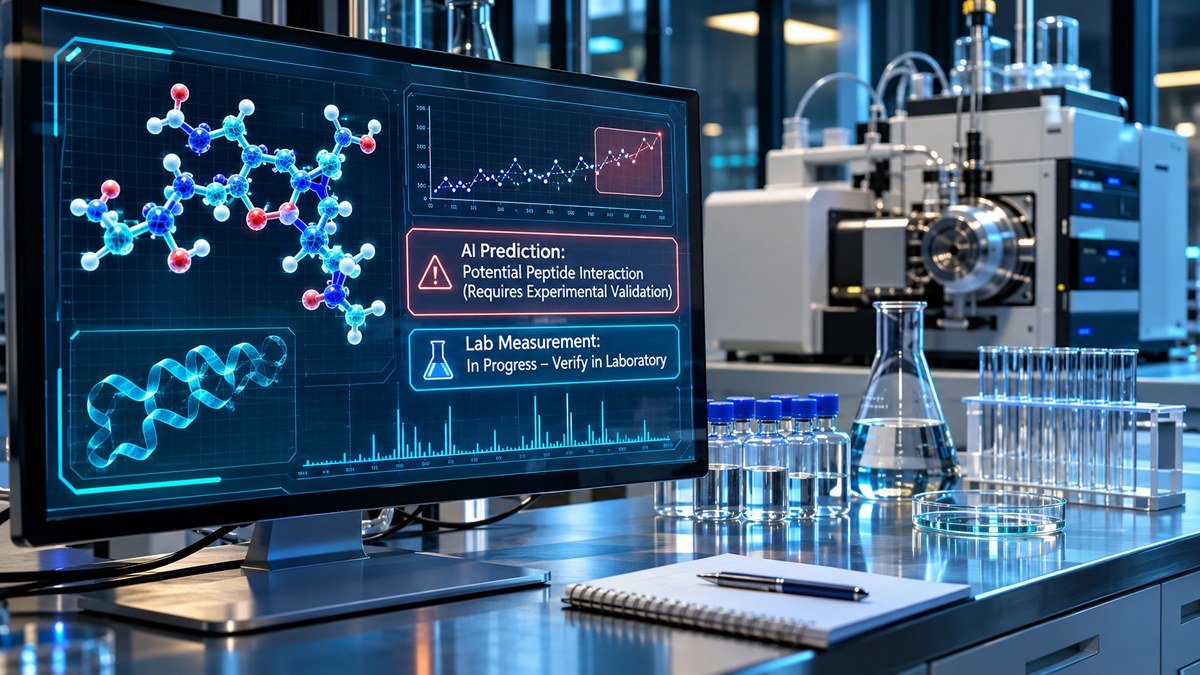
              Artificial intelligence can identify a promising pattern in a biological dataset within seconds. A laboratory may spend weeks investigating that same pattern and discover that it disappears when the experiment is repeated. This difference creates a difficult question for peptide researchers: when a computer predicts a meaningful biological relationship, what evidence is needed before scientists should trust it?

              You might also like

              Investigators Follow the Money as Passport Fraud Networks Profit From Fake Identities

              New Jersey Passport Fraud Case Exposes Online Fake-ID Sales and Cryptocurrency Payments

              How Biometric Boarding Connects Airline Gates With Government Identity Systems

              The problem is becoming more relevant as machine learning enters analytical chemistry, proteomics, molecular modeling, and drug-development research. Algorithms can process large datasets and suggest relationships that researchers might otherwise overlook. Yet the ability to discover a statistical pattern does not establish that the pattern reflects a genuine biological mechanism.

              Reliable scientific interpretation still depends on the quality of the original measurements, the suitability of the model, and independent experimental evaluation. Understanding those requirements is essential when assessing increasingly sophisticated claims about peptide-related research.

              Why a Convincing AI Prediction May Fail in the Laboratory

              Machine learning systems identify relationships within the information used to train them. If a dataset contains measurements of molecular structures, protein interactions, or biological responses, a model may learn combinations of variables associated with particular outcomes.

              Those associations can be useful for generating hypotheses. However, a model can also learn patterns produced by laboratory equipment, batch differences, incomplete observations, or mistakes in data preparation.

              Consider a hypothetical dataset assembled from several laboratory experiments. One instrument produces slightly different measurements from another because of calibration differences. If most samples associated with a particular experimental condition were analyzed using the first instrument, a predictive model might associate that condition with the instrument’s measurement characteristics.

              The resulting prediction could appear statistically convincing while offering little information about the underlying biological process. Testing the model with independently collected samples could expose the problem.

              This distinction matters because a high prediction score is meaningful only when the evaluation reflects the conditions under which the model will actually be used.

              The Scientific Difference Between Prediction and Confirmation

              A prediction describes an expected result based on available information. Confirmation requires additional evidence that the proposed relationship can be observed under suitable experimental conditions.

              In peptide research, computational methods may help scientists investigate molecular configurations, possible interactions, or patterns within experimental data. These outputs can guide further questions, but they do not independently establish biological activity, clinical effectiveness, or safety.

              A computationally predicted interaction, for example, is different from a measured interaction in a controlled laboratory experiment. A laboratory observation is also different from evidence demonstrating meaningful outcomes in humans.

              Each stage addresses a separate scientific question. Moving from one stage to another requires appropriate methods rather than an assumption that encouraging earlier findings will remain valid.

              The FDA addressed a related problem in its January 2025 draft guidance, “Considerations for the Use of Artificial Intelligence To Support Regulatory Decision-Making for Drug and Biological Products.”

              That document proposed a risk-based framework for assessing AI model credibility within a defined context of use. Its scope concerns AI-generated information used to support certain regulatory decisions, rather than every application of AI in scientific discovery.

              The broader lesson is that evaluating a model requires a clear explanation of what the model is expected to accomplish and what evidence supports its use for that specific purpose.

              Why the Original Laboratory Data Matters More Than the Algorithm’s Complexity

              An advanced algorithm cannot automatically correct an unreliable experimental record. Missing information about sample handling, measurement conditions, instrument performance, or analytical procedures can limit the usefulness of even a sophisticated model.

              Proteomics provides an instructive example. Researchers frequently use mass spectrometry to investigate proteins and peptides through complex analytical workflows. Producing interpretable results requires attention to sample preparation, instrument behavior, measurement consistency, and data processing.

              A 2024 paper in the Journal of Proteome Research, titled “A Framework for Quality Control in Quantitative Proteomics,” examined the importance of quality-control measures across proteomics workflows.

              The authors discussed approaches for identifying sample-preparation problems, tracking instrument performance, and distinguishing technical failures from sample-specific effects. Their work illustrates why measurement quality must be considered throughout an experiment rather than only after the final dataset has been created.

              When poor-quality observations enter a machine learning system, the resulting predictions may reflect those problems. Increasing the model’s complexity does not guarantee better scientific validity.

              A useful evaluation therefore begins with questions about how the dataset was produced, which observations were excluded, and whether the measurements can be compared meaningfully.

              How Peptide Identity and Analytical Quality Affect Research Interpretation

              Peptides are molecular chains composed of amino acids. Their sequence, structure, and chemical characteristics influence how they can be studied and identified.

              Researchers may use techniques such as liquid chromatography and mass spectrometry to investigate the composition and identity of peptide-containing samples. Different analytical methods answer different questions, and no single measurement automatically establishes every characteristic relevant to a scientific experiment.

              For example, identifying a molecular species does not by itself demonstrate that a sample has a particular biological effect. Likewise, a purity-related measurement does not establish clinical suitability or therapeutic effectiveness.

              Scientists examining peptide datasets must distinguish chemical identity, analytical purity, structural characterization, and biological activity. These are related areas of investigation, but they are not interchangeable.

              Educational resources such as Peptides Milwaukee can be considered within this broader discussion of peptide research terminology, provided readers independently evaluate the accuracy and supporting evidence behind any specific scientific claims.

              The important principle is that trustworthy interpretation requires matching each claim to the method capable of supporting it.

              When Weight-Management Research Becomes a Data Interpretation Problem

              Research involving metabolism and body-weight regulation can include different forms of evidence, including molecular experiments, laboratory measurements, animal studies, and controlled clinical investigations.

              These forms of evidence should not be presented as equivalent. A biological signal observed in a cell experiment cannot establish that the same effect will occur in a human population. An association discovered in an experimental dataset also does not prove that a particular molecular mechanism caused the observed result.

              AI systems may identify correlations among metabolic markers, molecular features, and experimental measurements. Such findings can help researchers formulate testable hypotheses, but the meaning of those predictions depends on study design and independent validation.

              Readers exploring a weight-loss peptide research category should therefore distinguish educational descriptions of research topics from evidence supporting an approved medical use.

              This distinction is especially important when a discussion combines investigational compounds with medicines that have established regulatory indications. Each compound requires its own evidence assessment and accurate regulatory context.

              Scientific interest alone does not demonstrate that a substance is appropriate for personal use, and computational findings cannot replace the evidence required to establish safety or effectiveness.

              Why Independent Test Data Is Essential for Reliable AI

              One of the most common challenges in machine learning is overfitting. A model may perform extremely well on familiar observations while struggling with data collected under different conditions.

              To investigate this problem, researchers divide available information into datasets used for model development and evaluation. However, a simple random division may not be sufficient when closely related observations appear in both groups.

              Imagine a laboratory collecting repeated measurements from the same original sample. If closely related measurements appear in both training and testing datasets, a model might appear more accurate than it would be when examining completely independent material.

              A stronger evaluation may require separating observations by source sample, experiment, laboratory, collection period, or another scientifically relevant grouping.

              The appropriate method depends on the actual research question. A model intended to analyze measurements from one controlled system may need a different evaluation from a model expected to perform across multiple laboratories.

              External validation is particularly informative because it investigates whether model performance persists beyond the information and conditions used during development.

              Researchers should also document cases where predictions fail. These failures may reveal limitations that average performance metrics conceal.

              The Hidden Importance of Measurement Uncertainty

              Laboratory measurements are estimates obtained through analytical processes. Every measurement has limitations arising from factors such as instrument behavior, calibration, sample preparation, and the characteristics of the method.

              The National Institute of Standards and Technology has published guidance describing how measurement uncertainty can be evaluated, expressed, and propagated when measurements contribute to further calculations.

              This concept matters when numerical laboratory observations become inputs for computational models. A dataset may report precise-looking values while providing insufficient information about how confidently those values were established.

              For example, two measurements that appear different may not provide persuasive evidence of a meaningful difference once their uncertainty is considered.

              Machine learning models can generate outputs containing many decimal places, but numerical detail should not be confused with accuracy. The precision of a displayed prediction does not establish the reliability of the underlying measurements.

              Responsible scientific reporting should explain uncertainty in terms that match the actual evidence. When uncertainty is not adequately characterized, readers may incorrectly interpret tentative findings as established results.

              Why Data Provenance Is Becoming an Important Research Technology Issue

              Data provenance describes the origin and processing history of information. In scientific research, this can include where measurements originated, when they were collected, which analytical methods were used, and what changes occurred during processing.

              Strong provenance records allow researchers to investigate unexpected results and understand whether different observations are reasonably comparable.

              Without that information, an AI-generated conclusion can be difficult to audit. A model may identify a pattern, yet investigators may be unable to determine which experimental conditions contributed to it.

              Useful documentation can include instrument identifiers, sample records, processing software versions, analytical settings, calibration history, and the procedures used to remove or transform observations.

              Not every project requires the same documentation system. Nevertheless, the ability to reconstruct the relationship between raw observations and published conclusions strengthens scientific accountability.

              This is especially relevant when datasets move between research groups or are reused for questions different from those that motivated their original collection.

              How Researchers Can Evaluate AI-Assisted Scientific Claims

              Before accepting an AI-assisted discovery claim, researchers can examine several aspects of the supporting evidence.

              • Research objective: Determine the specific scientific question the model was designed to address.
              • Data origin: Identify how the underlying laboratory measurements were collected and documented.
              • Analytical controls: Examine whether appropriate quality-control procedures supported the measurements.
              • Independent evaluation: Check whether the model was tested using observations sufficiently separate from its development data.
              • Uncertainty: Consider whether the reported differences are meaningful relative to measurement limitations.
              • Biological interpretation: Distinguish computational associations from experimentally demonstrated mechanisms.
              • Evidence boundaries: Determine whether conclusions remain within the limits of the experimental model and available studies.

              These questions are useful beyond peptide science. They apply to many settings where automated systems interpret complex scientific measurements.

              The purpose is not to dismiss computational research. It is to establish which findings are sufficiently supported to justify additional investigation.

              Why Transparency Matters for Scientific Education

              Public discussions of peptide research can become confusing when technical terms are presented without explaining their limitations. Words such as prediction, validation, purity, activity, and efficacy describe different aspects of scientific evaluation.

              A scientifically useful explanation should clarify the difference between an interesting hypothesis and an experimentally supported conclusion. It should also acknowledge when evidence remains preliminary.

              Readers consulting an organization’s background information, including the Peptides Milwaukee About Us page, can use that context as a starting point for examining how research information is presented and what supporting documentation is available.

              An organization’s description of its activities, however, is not a substitute for independent evidence supporting individual scientific claims.

              Transparency is particularly important when scientific content is made accessible to audiences outside specialized research institutions. Clear explanations help readers understand what an experiment measured, which questions remain unanswered, and why further work may be necessary.

              The Next Standard for AI-Assisted Peptide Research Is Verifiable Evidence

              Artificial intelligence is expanding the number of scientific relationships that researchers can investigate. It can help organize complex datasets, prioritize questions, and identify patterns deserving further attention.

              Yet technological sophistication does not change the fundamental requirements of scientific evidence. Observations must be measured reliably, methods must be documented, and conclusions must remain consistent with what the underlying experiments can demonstrate.

              For peptide research, that means keeping computational predictions separate from analytical confirmation, biological validation, and evidence concerning human outcomes.

              The most useful AI systems will be those whose results researchers can examine critically, reproduce where appropriate, and compare with independent measurements.

              A prediction becomes scientifically informative when investigators can explain why it should be trusted, identify its limitations, and determine what further evidence is needed. That standard gives AI a meaningful place in research without allowing an algorithm to replace the laboratory evidence on which dependable conclusions rest.


              Camille Morales

              Share30Tweet19
              Camille Morales

              Camille Morales

              Recommended For You

              Investigators Follow the Money as Passport Fraud Networks Profit From Fake Identities

              by Camille Morales
              November 15, 2026
              0
              Investigators Follow the Money as Passport Fraud Networks Profit From Fake Identities

              Criminal organizations profit from counterfeit document production, brokerage, distribution, and identity fraud, prompting investigators to pursue the financial infrastructure sustaining international passport forgery networks. WASHINGTON,

              Read more

              New Jersey Passport Fraud Case Exposes Online Fake-ID Sales and Cryptocurrency Payments

              by Camille Morales
              November 13, 2026
              0
              New Jersey Passport Fraud Case Exposes Online Fake-ID Sales and Cryptocurrency Payments

              Chicago defendant admits producing counterfeit U.S. passport cards and mailing fraudulent identification to New Jersey, revealing how online document sales can support identity theft, suspected bank fraud and...

              Read more

              How Biometric Boarding Connects Airline Gates With Government Identity Systems

              by Camille Morales
              October 27, 2026
              0
              How Biometric Boarding Connects Airline Gates With Government Identity Systems

              Participating airlines use facial comparison services to help verify travelers during boarding, linking airport cameras with government infrastructure in a process that can simplify document checks while raising...

              Read more

              Gaming, Headsets and Long Screen Sessions on the Neck and Wrists

              by Camille Morales
              October 27, 2026
              0
              Gaming, Headsets and Long Screen Sessions on the Neck and Wrists

              Gaming and immersive technology have changed how long people spend in a single position. A long session at a controller, a keyboard or inside a headset can run...

              Read more

              Boarding With Facial Recognition

              by Camille Morales
              October 26, 2026
              0
              Boarding With Facial Recognition

              Airlines, technology providers and government agencies can have different responsibilities for collecting, transmitting and processing boarding images, creating a chain of custody in which the organization operating the...

              Read more

              Leave a Reply Cancel reply

              Your email address will not be published. Required fields are marked *

              I agree to the Terms & Conditions and Privacy Policy.

              This site uses Akismet to reduce spam. Learn how your comment data is processed.

              Related News

              CEO of LQwD FinTech Discusses Bitcoin and How LQwD is Changing The Game, A Meta Talkz with Shone Anstey

              CEO of LQwD FinTech Discusses Bitcoin and How LQwD is Changing The Game, A Meta Talkz with Shone Anstey

              March 15, 2022
              Beyond Rarity: The Real Value Of NFTs: A Meta Talkz with Koby Karp

              Beyond Rarity: The Real Value Of NFTs: A Meta Talkz with Koby Karp

              September 20, 2022
              The Next Big Thing: One Company’s Journey Into The Metaverse, A Meta Talkz with Lisa M. Lum

              The Next Big Thing: One Company’s Journey Into The Metaverse, A Meta Talkz with Lisa M. Lum

              October 5, 2022

              Browse by Category

              Metaverse Times

              Disclaimer: Meta Talkz content is meant to be informational in nature and should not be interpreted as investment advice. Trading, buying or selling cryptocurrencies should be considered a high-risk investment, and every reader is advised to do their own research before making any decisions. We are not giving any financial or legal advice on this website.

              Our mission is to be the go-to media website for all things metaverse, crypto, blockchain, NFT's and Web 3.0

              CATEGORIES

              • "Legal"
              • "News"
              • AI
              • Art
              • Blockchain
              • Business
              • Crypto
              • Cryptocurrency
              • Cybersecurity
              • e-commerce
              • Economy
              • Entrepreneur
              • Finance
              • Health
              • Investing
              • Investment
              • Lawyer
              • Market
              • marketing
              • Mental Health
              • Meta Talkz
              • Metaverse
              • Network Engineer
              • NFT
              • Politics
              • Real Estate
              • Technology
              • Web3
              • World

              BROWSE BY TAG

              #Blockchain #Business #entrepreneur #NFT #NFT_Gaming #technology AI AI Governance Amicus International Consulting art artist Bitcoin brand authority Cryptocurrencies cryptocurrency Defi digital marketing E-Commerce Economy entrepreneurship Fed Tapering finance Instant Press Investment Legal Identity LocalSurge Marketing Market Stories media placement Meta Talkz Metaverse metaverse shopping microsoft Obligation press coverage real estate Second Passport second passports/citizenships small business Strategy Tax Techonology tokens Trading Web3
              • About
              • Advertise
              • Become a Contributor
              • Contact
              • Home
              • Meta Talkz TV Show
              • Podcast
              • Privacy Policy

              © 2024 meta talkz | All rights reserved.

              No Result
              View All Result
              • Home
              • About
              • Become a Contributor
              • Contact

              © 2024 meta talkz | All rights reserved.

              This website uses cookies. By continuing to use this website you are giving consent to cookies being used. Visit our Privacy and Cookie Policy.
              Are you sure want to unlock this post?
              Unlock left : 0
              Are you sure want to cancel subscription?