










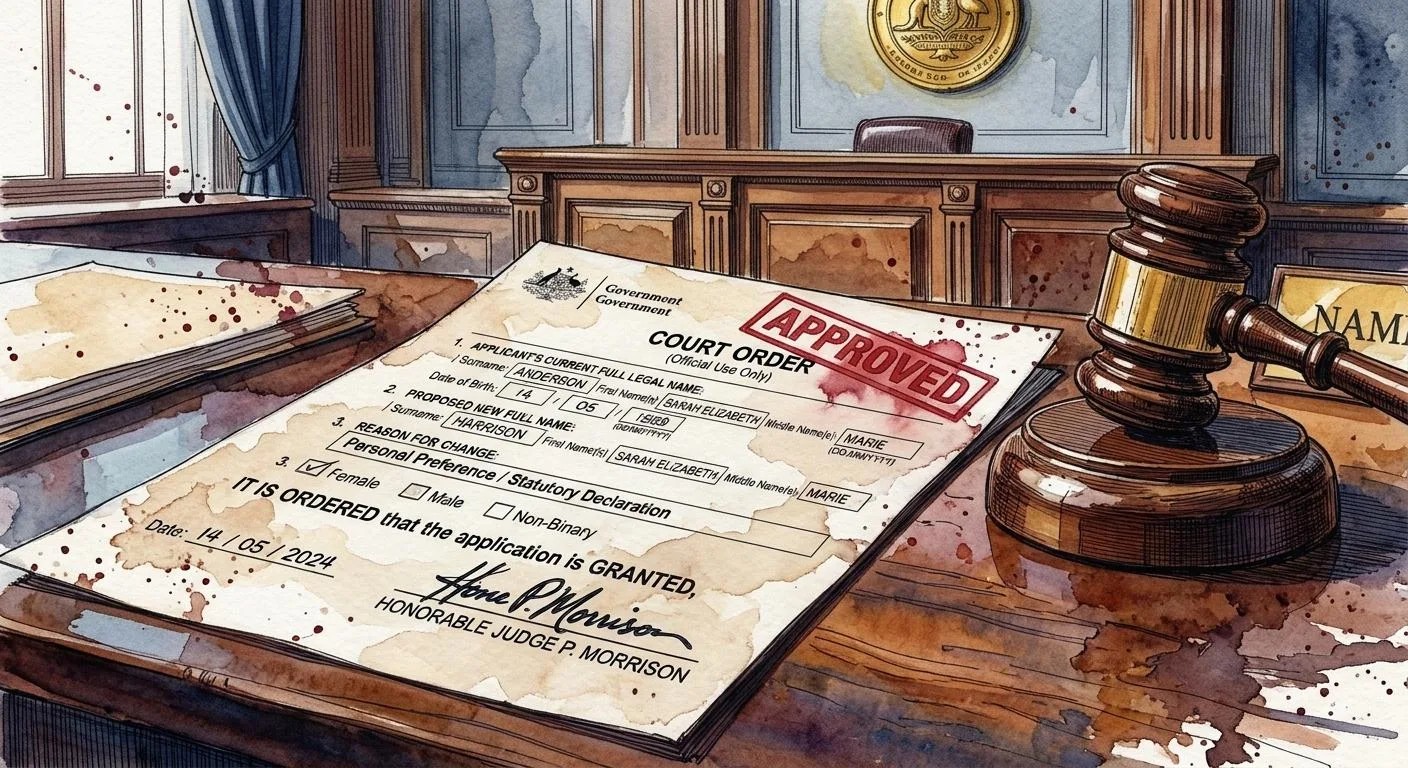
A court-approved name change updates identifying information while leaving questions about earlier records, continuing obligations and accurate disclosure to relevant institutions.
Washington, DC, November 3, 2026 — A court-approved name change can meaningfully recognize a person’s current identity, but the administrative work that follows generally involves connecting existing records to the new name rather than creating an unrelated legal history.
For people changing their names after marriage, divorce, a gender transition or another personal decision, that distinction matters when updating government identification, maintaining financial accounts, documenting qualifications and answering questions about information recorded under an earlier name.
The practical challenge is often continuity, because a person may need to demonstrate that an older employment record, educational credential or account belongs to them even though the document no longer matches their current identification.
Understanding what the court order establishes, which institutions require separate updates and how historical information should be handled can help applicants avoid treating a lawful change of name as a broader alteration of their legal circumstances.
The Court Order Establishes a New Name
California courts explain that a successful judicial name-change application produces an order stating the applicant’s new legal name, which the person can then use to update identification documents maintained by relevant government agencies and offices.
That explanation highlights an important distinction between receiving judicial approval and completing administrative updates: obtaining the order is one step, while presenting it to the organizations that maintain particular records is a separate part of the process.
Applicants should therefore read the actual order carefully, verify the spelling and other identifying information, and obtain the copies required for subsequent applications rather than assuming that every institution receives automatic notification from the court.
The California Courts guide to updating identity documents illustrates this additional work, directing applicants toward separate procedures for records such as Social Security information and state identification after the legal change has been approved.
Historical Documents May Still Establish Important Rights
An older document can remain useful evidence of an event, qualification or relationship even when it displays a previous name, making the connection between that document and current identification important during later administrative or professional transactions.
For example, someone presenting an educational credential issued before their name change may need to explain why the credential and their current identification differ, and the receiving institution will determine what documentation it accepts for that purpose.
The same practical question can arise when reviewing employment history or older account statements, although the appropriate response depends on the particular record and should not be reduced to an assumption that every document must be reissued.
A useful approach is to ask whether the institution requires an amended record, supporting proof connecting the names or both, then preserve the response so that subsequent requests can be handled consistently and without unnecessary duplication.
Social Security Updates Preserve Continuity
The Social Security Administration’s guidance on name-change documentation explains that a corrected card shows the new name while retaining the same Social Security number, demonstrating how an identifying detail changes without replacing the person’s underlying number.
The agency may accept a court order, marriage document, divorce decree or qualifying naturalization certificate as evidence of a name change, while also requiring sufficient information to establish that the applicant is the person reflected in its records.
If the name-change document does not provide enough identifying information, additional evidence may be necessary, including an identity document in the previous name under the circumstances described in the agency’s published guidance for corrected cards.
This process illustrates why historical identification can remain administratively relevant after a lawful change, even when the applicant intends to use the new name consistently and has already obtained a valid court order approving it.
Tax Records Require Consistent Identifying Information
The Internal Revenue Service advises taxpayers to ensure the name and Social Security number on a return match Social Security records, explaining that mismatches can delay processing and refund issuance.
Its guidance also addresses people who receive wage statements under different names after a name change, explaining that income should be reported on one return rather than split across separate returns based on the names on those statements.
When an employer issues a statement under an earlier name, the IRS directs the taxpayer to seek the appropriate correction, emphasizing the importance of properly crediting earnings and maintaining consistency across relevant reporting systems.
These instructions reflect an administrative connection between earlier and current information, rather than suggesting that a new name separates income earned before the change from the individual responsible for reporting it under the applicable tax rules.
Passport Updates Follow Their Own Procedures
A passport does not automatically change when a court approves a name change, and the Department of State explains that the applicable update procedure depends on circumstances, including when the passport was issued and when the name changed.
The supporting documents can include an original or certified name-change record, such as a marriage certificate, divorce decree or court order, with the appropriate application route determined by the traveler’s eligibility and the relevant passport instructions.
For someone preparing an international journey, this creates a practical reason to review passport requirements before making arrangements that depend on the new name, rather than assuming that possession of the court order completes the passport process.
The department’s guidance treats the change as an update requiring evidence, reinforcing the importance of preserving the document that connects the earlier passport details with the information the applicant now asks the government to recognize.
Existing Obligations Require Separate Attention
A person considering a name change should distinguish the recognition of a new name from any separate legal process affecting an outstanding obligation, rather than assuming that a different name changes the substance of an existing dispute.
San Francisco Superior Court’s published adult name-change guidance identifies avoiding debt collectors, hiding from the law and committing fraud among improper reasons for seeking a change, illustrating that the procedure is not intended to facilitate those purposes.
Where someone has an unresolved financial or legal matter, the useful question is what action is required within that matter, including whether records need updating and which professional or institution can explain the applicable requirements.
Keeping those questions separate helps prevent an administrative change from being mistaken for substantive relief, while allowing the individual to use their approved name accurately in communications concerning responsibilities that arose under an earlier name.
Credit Report Errors Need Targeted Corrections
The Consumer Financial Protection Bureau identifies incorrect names, mixed files and accounts resulting from identity theft as examples of credit-reporting errors, making a careful review useful when identifying information changes or unfamiliar information appears in a report.
A mixed file combines information from different consumers, which differs from an accurate historical record appearing under a person’s previous name and should be evaluated on its own facts.
The bureau advises consumers to dispute inaccurate or incomplete information with the credit reporting company and the business that supplied it, providing supporting documentation that explains what is wrong and why the information requires correction.
The practical objective is an accurate record, so a name update should be paired with a focused review of disputed information rather than assuming every earlier entry is inaccurate simply because it uses the previous name.
Confidentiality Measures Have a Defined Scope
Privacy protections can change who may access certain court records, but applicants should examine the specific rule or order before assuming that protection extends to every institution holding information about their earlier name or personal history.
California Courts explains that, beginning July 1, 2026, petitions and related records in specified gender-related name-change and recognition proceedings generally receive confidentiality protections, with separate procedures available for qualifying cases filed before that date.
The guidance identifies categories of people who may access protected records and distinguishes circumstances before and after approval, demonstrating that confidentiality operates through defined access rules rather than an unrestricted promise that no records will exist.
For an applicant concerned about safety or sensitive information, the key questions are which records are protected, who retains authorized access, and what additional arrangements may be needed when updating records held outside the court system.
Criminal Record Relief Is a Different Legal Process
Changing a name and obtaining relief concerning a criminal record involve different legal questions, so it’s important to identify the specific record and available procedure rather than treating a name-change order as an answer to both.
California courts provide separate guidance on cleaning criminal records and explain that available options depend on the situation, illustrating why someone seeking record relief needs an assessment focused on that objective and the relevant history.
The same court system explains that a certificate of rehabilitation does not erase a criminal record, showing that even rehabilitation-focused procedures have limits that require careful examination before applicants describe their legal effect.
Anyone completing a background-related form should therefore distinguish a name change from any dismissal, sealing order, or other relief actually obtained, then seek advice on the specific question instead of assuming all procedures produce identical disclosure consequences.
Accurate Disclosure Depends on the Actual Question
A form requesting a current legal name asks a different question from one requesting earlier names, and careful completion requires attention to that distinction rather than using the newly approved name as a universal response.
Applicants should read the instructions for the particular transaction, including any relevant definitions, time periods or exceptions, because a requirement governing one institution should not automatically be assumed to govern every other application or interaction.
Where the instructions are unclear or disclosure raises a legitimate confidentiality concern, seeking clarification through an appropriate official or legal adviser can help identify how to answer accurately without unnecessarily circulating sensitive information beyond the relevant process.
This approach supports both privacy and reliable records, because it focuses on providing the information actually required for a defined purpose while avoiding unsupported assumptions about what a court-approved name change permits someone to omit.
Commercial Descriptions Need Careful Interpretation
Commercial language about a new identity can mean different things to different readers, so it helps to identify the proposed government procedure and the expected resulting documents before assessing the implications.
Readers reviewing Amicus International Consulting’s new-identity services should distinguish service descriptions from the legal effect of any particular court order or government-issued document, which must be evaluated under applicable law and individual circumstances.
Useful questions include which authority approves the change, what accurate supporting information must be supplied, and how existing records will be updated, since those details provide a more concrete basis for assessment than broad descriptions of a fresh start.
A written explanation of scope can also help separate assistance with applications from claims about historical records or ongoing obligations, ensuring the applicant understands what the proposed service addresses and which matters require separate professional advice.
A Documented Transition Supports Reliable Records
A practical transition plan begins with an inventory of the records that need attention, followed by confirmation of each organization’s requirements, so that the applicant can prioritize dependent updates and avoid submitting incomplete or inconsistent information.
Keeping certified copies where required, recording submission dates, and retaining official responses can make follow-up easier, particularly when different institutions complete updates at different times or request additional evidence linking the previous and current names.
Preserve historical documents securely when they remain relevant to establishing a qualification, transaction, or entitlement, while appropriately limiting access where the change involves personal safety or information the individual reasonably wishes to protect.
A lawful name change can be significant without making earlier records irrelevant, and the most effective administrative outcome is a clear, accurate connection between the person’s recognized name, their existing records and the obligations or rights those records document.