









Session-specific cryptographic keys help shield wireless exchanges against interception and unauthorized modification.
WASHINGTON, DC, October 13, 2026 — Electronic passports communicate with inspection equipment through a contactless radio-frequency interface, so encryption and message-integrity protections matter because sensitive identity information must remain protected as it moves wirelessly between the passport chip and an authorized reader.
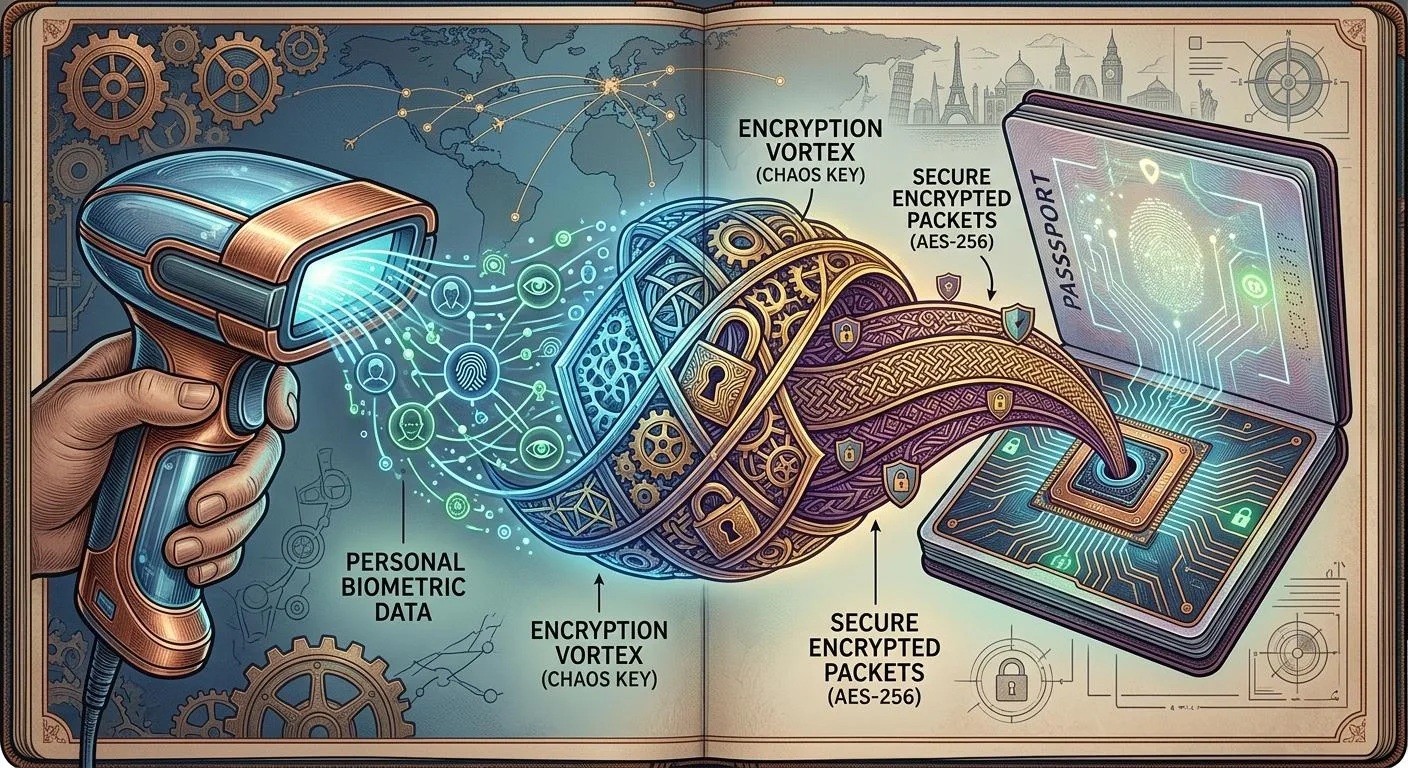
Modern electronic passport protocols establish session-specific cryptographic keys that protect commands and responses during an individual interaction, allowing compatible inspection systems and passport chips to exchange information through a secured channel rather than transmitting ordinary identity data as openly readable wireless traffic.
Contactless Communication Requires More Than Access Control
Preventing an unauthorized device from starting a passport-reading session addresses one important security problem, but protecting the information transmitted after legitimate access begins requires another layer that secures communication throughout the electronic interaction.
An authorized border reader may legitimately retrieve biographical information, a digital facial image, security objects, and other permitted passport records, meaning the radio-frequency exchange carrying those data also needs protection against interception or unauthorized modification while the session remains active.
The ICAO electronic passport security framework defines secure-messaging mechanisms that protect electronic machine-readable travel-document communications after appropriate protocols establish the cryptographic keys used during the interaction.
Session Keys Protect a Particular Electronic Interaction
Instead of relying on a single encryption credential for every passport reading throughout the document’s lifetime, supported access protocols derive session keys for communication during the current electronic interaction.
These temporary credentials let the passport and reader protect the session without exposing permanent private authentication keys or requiring the traveler to use a conventional user-selected password for routine border inspection.
ICAO specifies that secure-messaging keys can be established through mechanisms including Basic Access Control, PACE, and Chip Authentication, and that those keys can change as stronger security procedures are applied later in the same electronic session.
Encryption Protects Confidentiality
One purpose of secure messaging is confidentiality, meaning information transmitted between the passport and inspection terminal is encrypted so an outside observer capturing the wireless exchange cannot simply interpret the underlying passport data directly.
This protection matters because electronic passports can contain standardized identity information and a high-quality facial image, and unnecessary disclosure would raise privacy concerns even if the document remains genuine.
Encryption therefore protects information in transit between trusted endpoints, complementing the controls that protect data stored inside the passport chip.
Integrity Protection Guards Against Unauthorized Modification
Confidentiality alone is insufficient because an attacker might modify encrypted messages or substitute electronic commands without necessarily understanding the underlying information they carry.
Secure messaging therefore incorporates authentication or integrity mechanisms that let the receiving device determine whether the legitimate sender altered protected commands and responses after they were generated.
ICAO’s secure-messaging specifications use an encrypt-then-authenticate structure for supported mechanisms, meaning protected information is encrypted and then incorporated into an authentication calculation before the resulting message crosses the contactless interface.
Encryption and Authentication Perform Different Jobs
Encryption primarily prevents unauthorized parties from understanding the protected message contents, while message authentication helps the receiver determine whether those protected contents were modified during transmission.
A secure electronic passport channel benefits from both protections because confidential information should remain unreadable to outsiders, while legitimate participants also need confidence that commands and responses arrive as originally transmitted.
Combining confidentiality with integrity therefore provides substantially stronger protection than encrypting data without mechanisms to detect unauthorized manipulation.
The Keys Are Derived Rather Than Simply Printed on the Passport
Secure communication does not ordinarily depend upon a long encryption key visibly printed somewhere inside the document, because supported protocols derive cryptographic session keys through defined exchanges between the passport and reader.
This approach allows ordinary document information or authenticated cryptographic credentials to contribute to session establishment while producing stronger keys whose security characteristics exceed those of the initial access information alone.
The resulting architecture separates the information used to initiate access from the stronger cryptographic material that later protects the active electronic conversation.
PACE Establishes Strong Session Keys
Password Authenticated Connection Establishment, commonly known as PACE, uses document-associated information as a starting credential while performing a cryptographic exchange that produces strong session keys for subsequent secure messaging.
ICAO states that PACE provides strong session keys regardless of the initial password’s limited strength, allowing machine-readable-zone information or a Card Access Number to authorize the connection without directly becoming the final session encryption credentials.
The ICAO Traveller Identification Programme places these electronic security mechanisms within the wider international framework supporting interoperable passports, inspection systems, identity management, and border-control technologies.
Basic Access Control Also Established Encrypted Sessions
Earlier generations of electronic passports commonly used Basic Access Control, or BAC, which derived encryption and message-authentication keys from selected information contained within the passport’s machine-readable zone.
BAC represented a significant improvement over completely unrestricted contactless communication, although later protocols such as PACE were developed to provide stronger protection against contemporary interception and password-related attacks.
The coexistence of older and newer passport generations means border inspection systems may encounter different secure-channel mechanisms while legitimate documents continue circulating throughout their prescribed validity periods.
Chip Authentication Can Replace Earlier Session Keys
Chip Authentication adds another important capability because its cryptographic key-agreement procedure can establish fresh session keys while also providing additional evidence that the electronic component possesses credentials associated with the legitimate passport.
Once Chip Authentication succeeds, subsequent communication can use the newly derived keys rather than continuing indefinitely with the credentials established during the earlier access stage.
This progression lets a passport session become cryptographically stronger as additional authentication procedures succeed, showing how modern electronic security can build protections sequentially instead of relying on one permanent connection state.
Fresh Keys Limit Dependence on Previous Sessions
Session-specific cryptographic material separates one passport interaction from another, so the keys protecting a legitimate exchange at one inspection point don’t serve as permanent, reusable credentials for later encounters.
This separation reduces the usefulness of information captured during an earlier interaction because future sessions can derive different cryptographic values rather than automatically reproducing the same protected communication state.
The general principle resembles other secure digital systems in which temporary session credentials reduce dependence on long-lived encryption material while preserving the permanent secrets required to establish trust.
A Shared Secret Becomes Several Cryptographic Keys
Electronic passport protocols can derive separate keys for encryption and message authentication from cryptographic material established during the applicable access or authentication procedure.
ICAO specifications describe distinct secure-messaging keys for encryption and authentication, allowing confidentiality and integrity to operate independently while remaining tied to the same underlying protected session.
This separation lets each cryptographic function perform a defined role rather than relying on a single undifferentiated value for every operation between the passport and inspection system.
Secure Messaging Protects Commands as Well as Responses
Electronic passport communication involves more than simply downloading one identity file because the inspection system sends structured commands requesting information or initiating security procedures while the chip returns corresponding responses.
Secure messaging can protect both directions of that interaction, preventing an observer from freely reading ordinary protected exchanges and helping participants identify unauthorized modifications to legitimate commands or responses.
This bidirectional protection matters because interfering with instructions sent to the passport can raise security concerns, just as intercepting information returned by the passport can threaten confidentiality.
Sequence Controls Help Preserve Message Order
Secure communication mechanisms can also maintain sequencing information so protected messages remain connected to their expected position in the ongoing electronic interaction rather than existing as isolated encrypted packets.
ICAO secure-messaging specifications define a Send Sequence Counter that advances as commands and responses are produced, incorporating session progression into the protected communication environment.
Sequence information helps the two devices maintain a coordinated cryptographic state while adding another obstacle against simplistic attempts to reuse protected messages outside their expected context.
Eavesdropping and Skimming Are Different Threats
Skimming involves attempting to communicate directly with a passport without the holder intentionally presenting it, while eavesdropping involves observing communication already taking place between the document and a legitimate reader.
Access controls such as PACE help address the first problem by regulating how communication begins, while encrypted secure messaging becomes especially important for the second problem because it protects data exchanged during an authorized session.
The two safeguards therefore complement one another by protecting both entry into the electronic interaction and the information moving through that interaction afterward.
Intercepted Radio Traffic Should Not Reveal Ordinary Passport Data
When secure messaging works correctly, someone who can detect radio-frequency communication between a passport and reader should encounter cryptographically protected traffic rather than straightforward representations of names, dates, facial images, or other protected information.
This does not make interception physically impossible, because radio transmissions can be observed, but encryption substantially reduces the usefulness of captured traffic by preventing straightforward interpretation without the relevant session credentials.
Electronic passport security therefore focuses not only on preventing observation but also on making observed communication substantially less intelligible and useful to unauthorized parties.
Modification Becomes More Detectable
An attacker trying to change protected communication faces another difficulty: message-integrity mechanisms let the recipient check whether the received information matches the cryptographic authentication associated with the legitimate session.
An unauthorized modification should therefore cause the expected verification relationship to fail rather than silently producing a valid protected command or response accepted without additional scrutiny.
This capability helps distinguish secure messaging from ordinary radio encryption because confidentiality and integrity protection work together rather than treating secrecy as the only objective.
Secure Messaging Does Not Authenticate the Passport Issuer
A successfully encrypted connection establishes protected communication between the current chip and reader, but it does not independently establish that the electronic information originated from the sovereign government identified on the passport.
Passive Authentication performs that separate function by checking digitally signed passport information against trusted issuing credentials and determining whether protected data remain unchanged from legitimate personalization.
Secure communication protects the transport channel, while digital signatures provide evidence of the origin and integrity of the records transported through that channel.
A Protected Channel Can Carry Unverified Data
An encrypted session can theoretically transport electronic information whose authenticity has not yet been established, just as a secure network connection does not automatically guarantee that every file transmitted through it contains truthful or legitimate information.
Inspection systems therefore distinguish connection security from document authentication and perform additional cryptographic procedures when determining whether to trust stored passport records.
This layered design prevents encryption from becoming an all-purpose authenticity indicator for questions secure messaging was never designed to answer.
Chip Authenticity Requires Another Mechanism
A protected wireless session also does not necessarily establish that the electronic component is the original chip associated with the legitimate passport, particularly when the initial session was established through access-control procedures alone.
Chip Authentication, or Active Authentication, can provide additional evidence about the electronic component by requiring cryptographic capabilities tied to protected private credentials rather than relying solely on successful communication.
The resulting sequence separates confidential transport from hardware authentication, allowing each security mechanism to address the specific risk for which it was designed.
The Traveler Remains Outside the Encryption Test
Encryption cannot determine whether the individual carrying the passport is its legitimate holder because secure messaging protects communication between electronic devices rather than comparing the traveler with the identity represented within the document.
After the system obtains and authenticates the electronic facial image, biometric comparison can evaluate whether the live traveler corresponds with that protected reference portrait.
A genuine passport used by another person can therefore establish a fully secure encrypted session while still creating a problem during the later holder-verification stage.
Current Passport Status Is Separate Again
A canceled, revoked, or reported-lost passport can theoretically retain perfectly functional encryption capabilities because the administrative event changing its legal status does not necessarily modify the chip or its session-establishment mechanisms.
Government status databases therefore remain necessary when authorities need to determine whether a technically functioning electronic passport remains acceptable for current use.
This distinction shows why border verification combines communication security, document authentication, identity verification, status checking, and immigration rules rather than expecting one cryptographic protocol to do everything.
Session Encryption Does Not Replace Physical Security
Contactless encryption cannot determine whether someone disturbed the passport binding, altered the laser engraving, modified a hologram, replaced a page, or interfered with another physical element outside the electronic communication channel.
Physical security features remain valuable precisely because they provide evidence based upon materials, manufacturing, printing, personalization, and booklet construction that secure messaging cannot inspect.
Electronic and physical defenses therefore remain complementary even as border systems increasingly depend upon automated chip communication.
Consumer Applications Can Establish Protected Sessions
Compatible smartphone applications can establish encrypted communication with many electronic passports after obtaining the information required by the supported access protocol, showing that secure messaging is not limited to large airport inspection terminals.
However, successfully establishing a protected smartphone connection does not necessarily mean the application then authenticates digital signatures, performs chip authentication, compares biometrics, or checks government passport-status systems.
Understanding which layer an application actually completed remains essential when interpreting claims that a passport was successfully read or verified.
Encryption Results Are Usually Invisible to Travelers
A traveler presenting a passport at an automated gate typically does not see the session keys, cryptographic algorithms, message-authentication calculations, or counters the reader uses while communicating with the chip.
These operations occur within the background security architecture, enabling secure communication that supports routine border processing without requiring travelers or frontline officers to manage cryptographic settings manually.
The simplicity of the visible interaction therefore conceals a significantly more complex electronic conversation occurring between the document and inspection infrastructure.
Secure Messaging Must Remain Interoperable
International passports need to communicate securely with inspection systems operated by countries other than the issuer, making standardized cryptographic structures essential if encryption is expected to support global travel rather than one national environment.
ICAO specifications provide common mechanisms for session establishment and secure messaging so compliant passport chips and compatible foreign inspection systems can protect their communication using agreed technical procedures.
Interoperability lets governments strengthen wireless privacy without creating proprietary encryption systems that other legitimate border authorities cannot understand or support.
Algorithm Strength Evolves Over Time
Electronic passport generations can support different cryptographic algorithms because security standards evolve as computing capabilities, cryptographic research, and implementation practices change during the long lifespan of international travel-document programs.
Current ICAO specifications include AES-based secure-messaging configurations alongside legacy mechanisms associated with earlier passport generations, allowing stronger contemporary implementations while maintaining appropriate compatibility with valid older documents.
Border systems must understand the algorithms legitimately associated with each passport generation before interpreting technical differences as evidence of a document problem.
Encryption Cannot Protect Poorly Managed Endpoints
A strong encrypted channel protects information while it moves between the passport and reader, but its benefits can be reduced when either endpoint mishandles information after legitimately decrypting it.
Inspection systems therefore require appropriate access controls, secure software, protected networks, authorized personnel, and responsible handling practices in addition to strong cryptographic communication protocols.
End-to-end passport security depends on the entire processing environment, not on the assumption that wireless encryption alone can protect identity information after authorized systems receive it.
Session Keys Reduce Exposure of Long-Term Secrets
Temporary session credentials also protect long-lived cryptographic secrets because ordinary communication can use derived keys rather than repeatedly exposing permanent private credentials with every command and response.
The permanent secret may help establish or authenticate the session, while the temporary keys handle most subsequent encrypted communication.
This division limits unnecessary use of the most sensitive credentials and reflects a broader cryptographic principle used across many secure systems beyond electronic passports.
The Secure Channel Provides a Foundation for Later Processing
Once the inspection system establishes protected communication, it can retrieve electronic passport information for subsequent integrity checks, biometric comparison, or other authorized operations without sending those exchanges over an unprotected wireless channel.
Secure messaging therefore provides transport protection that supports later verification procedures rather than serving as the final authenticity decision.
This distinction matters because a secure channel protects how information moves, while separate mechanisms establish whether the information, chip, physical document, and traveler deserve trust.
Protected Communication Supports Privacy and Security Together
Encryption is often discussed as a security measure, but secure messaging in electronic passports also serves an important privacy function by limiting the intelligibility of personal data transmitted over a wireless interface during legitimate inspection.
A traveler can therefore benefit from cryptographic protection even when no fraudulent passport activity exists, because preventing unnecessary exposure of genuine identity information remains valuable independently of detecting counterfeit documents.
The same secure channel also supports operational integrity by helping legitimate devices detect unauthorized modifications to protected exchanges.
Wireless Convenience Requires Cryptographic Discipline
Contactless passport technology enables fast electronic inspection without a physical electrical connector between the document and reader, but that convenience makes disciplined communication security especially important because radio-frequency exchanges travel through the surrounding environment.
Session encryption, message authentication, sequence controls, and carefully derived keys transform that wireless interaction from simple contactless data retrieval into a protected cryptographic conversation between compatible devices.
These protections show how electronic passports can preserve the operational advantages of contactless technology while reducing the risks of transmitting sensitive information in the open.
Session Security Is One Layer Within a Larger Architecture
Through Amicus International Consulting’s passport security resource, readers can examine how encrypted communication works alongside access control, digital signatures, chip authentication, physical document security, biometrics, and government verification systems within contemporary passport inspection.
The strongest electronic passport systems don’t treat encryption as a substitute for those other checks because secure communication answers a specific question: how data travels safely between the chip and reader.
Encrypted Connections Protect the Electronic Conversation
Session-specific cryptographic keys help electronic passports and inspection systems create protected communication channels that encrypt and authenticate sensitive information as it travels across the contactless interface.
These protections make intercepted traffic far less useful, help detect unauthorized message modification, and reduce reliance on permanent credentials by establishing temporary keys for the current electronic interaction.
Combined with document authentication, chip verification, physical inspection, biometric comparison, and government status checks, encrypted communication ensures that modern passport security protects not only the stored identity information but also the electronic path through which legitimate authorities retrieve and examine it.