









What this covers
-
What a Sample Is Actually For
-
The Case Where Instruments Have Already Answered It
-
What the Public Health Guidance Actually Says
-
When a Sample Genuinely Earns Its Fee
-
The Cost of Sampling That Was Never Needed
There is a widespread assumption that testing is the point of a mold assessment, and that an assessment without laboratory work is somehow incomplete. It is worth examining, because it is often the reverse.
Sampling is a tool for answering a specific question. Where the question has already been answered by other means, a sample adds a fee, adds days to the timeline, and returns a number that changes nothing.
What a Sample Is Actually For
Three sampling methods get used, and they answer three different questions.
Air sampling draws a measured volume of air across a slide inside a cassette and reports what is circulating in that room at that moment. Surface sampling lifts material from one specific place and reports what that patch of material is. Bulk sampling removes a section of material and reports what is inside it rather than on it.
Using the wrong one produces a technically accurate answer to a question nobody asked. Taking all three without a reason produces three of them.
The item most often missing from a cheap quote is the outdoor control. An indoor count only means something next to an outdoor sample taken the same day with the same equipment, because outdoor air carries fungal spores as a matter of course. Without that baseline there is no scale, and a number with no scale cannot be called high or normal.
The Case Where Instruments Have Already Answered It
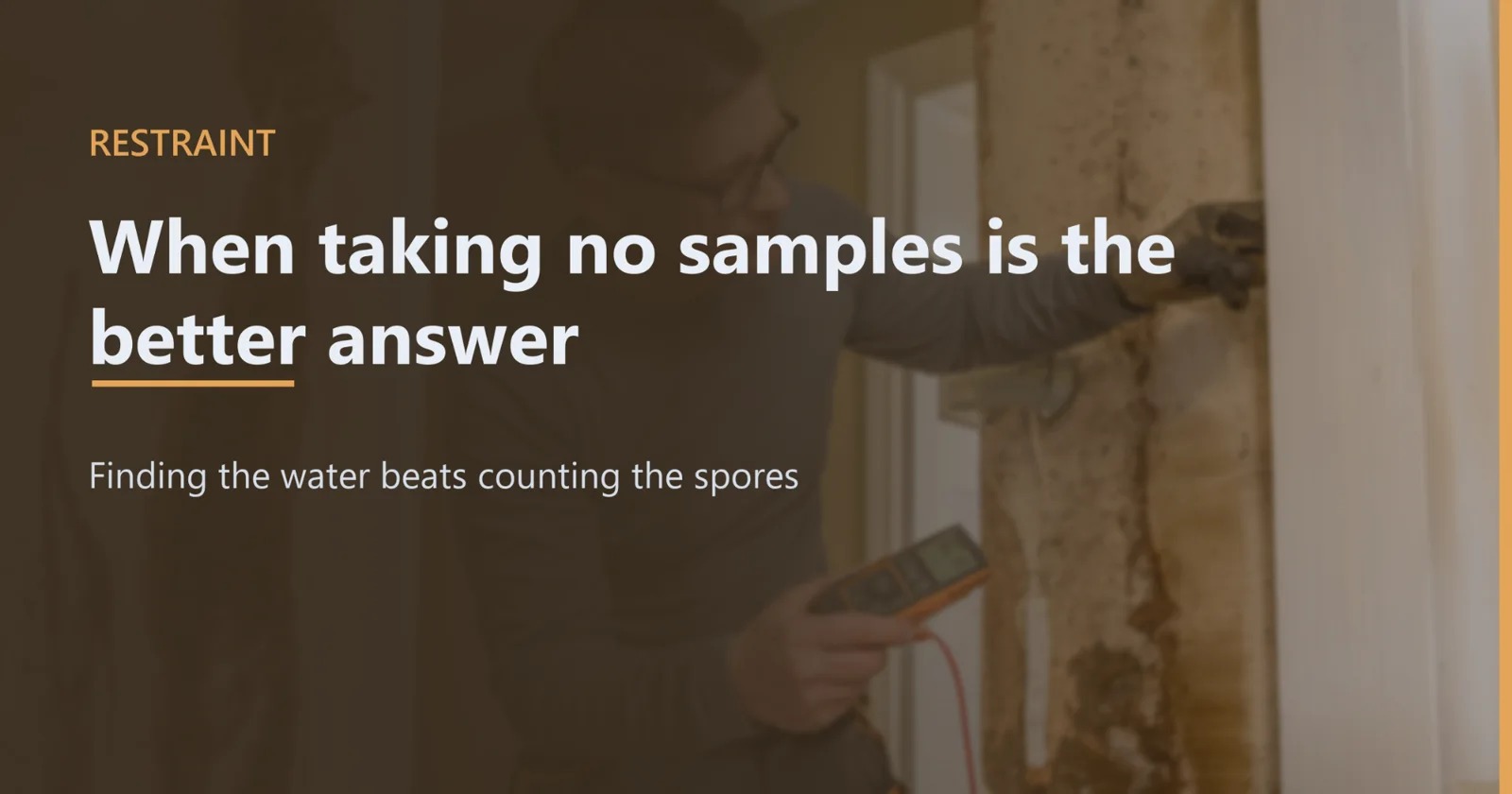
The most common situation where sampling adds nothing is also the most ordinary one. There is visible growth, there is an obvious source of water, and moisture readings confirm the extent of the affected material.
At that point the useful questions are where the water is coming from, how far it has traveled inside the structure, and what has to be dried or replaced. None of those are answered by a spore count. They are answered by a moisture meter, by thermal imaging, and by looking at the roof, the plumbing or the ground outside.
Identifying what is growing can still be interesting. It is rarely decisive. The response to sustained dampness in a wall cavity does not change much according to which genus is present, because the correct response is to stop the water and deal with the affected material either way.
What the Public Health Guidance Actually Says
This is the part that surprises people, and it is worth stating plainly because the testing industry does not advertise it.
The California Department of Public Health’s position on building dampness and mold is that there are no science-based numerical exposure limits for indoor mold, and it does not recommend air sampling as a way to judge health risk. The federal position is the same in substance: no standard exists for airborne mold concentrations.
That does not make sampling useless. It makes sampling a tool for answering building questions rather than medical ones. A result cannot tell anybody whether a person will become unwell, because there is no threshold to compare it against. It can establish whether one room differs from the outdoor baseline, whether a sealed area differs from an unsealed one, or whether counts came down after work was done.
Those are real questions. They are just narrower than the ones people expect a test to settle.
When a Sample Genuinely Earns Its Fee
There are four situations where laboratory work is the right call rather than an upsell.
Where the question is hidden growth behind a finish and moisture readings are ambiguous, an air sample can indicate whether something is contributing to the air of that room.
Where a dispute exists between two parties, documented sampling against a same-day outdoor control produces evidence rather than opinion. In a tenancy or a shared building, that is usually what the argument turns on.
Where a sealed and unsealed area need comparing during or after work, sampling establishes whether containment is doing its job.
And where remediation has been completed, clearance testing establishes whether counts have come down. That one has a condition attached: verification carried out by the firm that did the removal is not verification. It should be a separate visit by somebody with no stake in the result.
The Cost of Sampling That Was Never Needed
Each sample carries a laboratory fee, and the fees are where a quote inflates quietly. A fixed number of samples committed to before anybody has looked at the property is pricing a product rather than answering a question.
The timeline cost is larger and less visible. Standard laboratory processing runs to several business days. Where a purchase deadline is running, a round of unnecessary sampling can be the difference between making a decision inside a contingency period and not. Anyone weighing how long a mold inspection takes against a contractual date is really weighing whether the laboratory step is needed at all.
There is a structural reason this restraint is uncommon. Most firms that assess a property also sell the removal, so the assessment is a route to a larger contract and a thorough-looking test list supports a thorough-looking scope. An assessor who performs no remediation has nothing riding on the size of the answer, and is free to say that the instruments found the source, that sampling would add a week and a fee, and that it would not change what needs doing. The practice behind this article can be found on Google Maps here.
The test worth applying to any quote is simple. Ask what question each proposed sample answers, and what would be done differently depending on the result. A quote that can answer that for every line is a considered one. A quote that cannot is selling laboratory work.