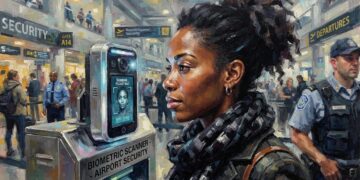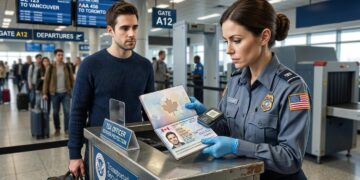










Participating airlines use facial comparison services to help verify travelers during boarding, linking airport cameras with government infrastructure in a process that can simplify document checks while raising important questions about data flow, traveler choice and the distinction between airline operations and sovereign border control.
WASHINGTON, DC, October 26, 2026. Biometric boarding is changing the final moments before international departure by allowing participating airlines and airport operators to capture a traveler’s photograph at the gate and transmit that image to government facial-comparison infrastructure capable of confirming whether the person appears to correspond with an expected passenger identity.
The Boarding Camera Is Often Only the Front End
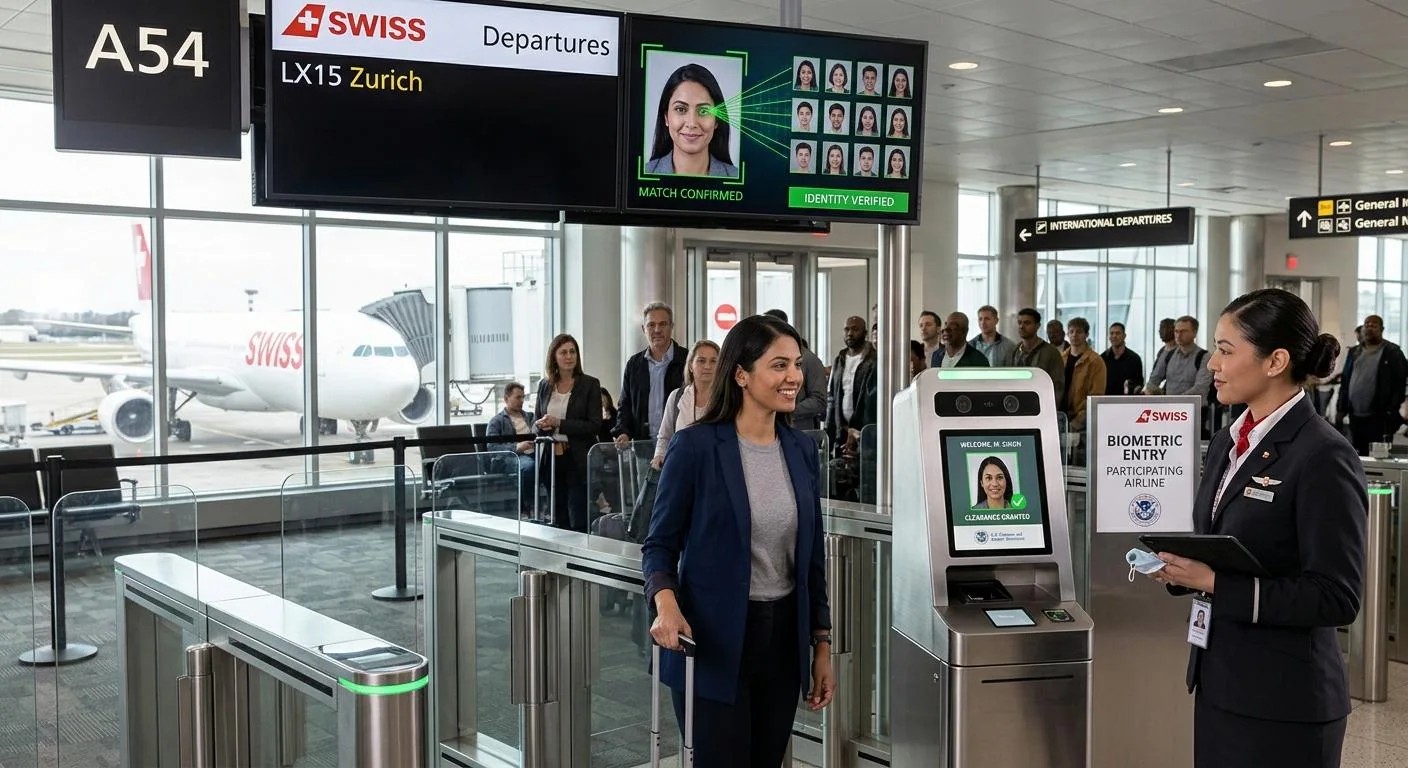
At a biometric boarding gate, the camera visible to the traveler may belong to an airline, airport authority or another transportation partner, but the actual facial comparison can occur within a government service operating remotely from the physical boarding area.
U.S. Customs and Border Protection explains that CBP can capture photographs used in its biometric entry and exit program, or travel partners such as airlines, airport authorities, and the Transportation Security Administration can, before securely transmitting them to the agency for identity verification.
That architecture means the gate camera does not necessarily contain the government’s passport or immigration database, because the airline can submit a photograph to the government system and receive a verification response without unrestricted access to the underlying biometric records used for comparison.
The distinction matters because biometric boarding can look like an airline facial recognition program from the passenger side, while the critical matching function depends on government information and government-controlled comparison infrastructure operating behind the visible airport equipment.
CBP Uses the Traveler Verification Service
In the United States, the central government service supporting many biometric travel interactions is CBP’s Traveler Verification Service, commonly known as TVS, which provides facial comparison capabilities for international entry and departure as well as selected transportation-security and airline workflows.
A joint TSA and CBP report describes TVS as an identity-as-a-service capability that uses existing government traveler information to create smaller galleries containing facial images associated with a particular departing flight, rather than searching every government photograph for every passenger.
The resulting architecture lets an airline or airport partner capture a live image at the boarding gate and submit it to TVS, where the system compares the traveler with the relevant flight gallery and returns a verification result within seconds.
For the traveler, the face can therefore serve as a convenient identity token at the boarding gate, although the underlying process remains a government-supported facial comparison rather than an airline independently building a complete biometric identity database from scratch.
Flight Manifests Help Build Smaller Facial Galleries
Government facial comparison at boarding does not necessarily start with the camera trying to identify an unknown person among millions of unrelated individuals, because passenger manifest information can narrow the expected traveler population before boarding begins.
CBP and TSA documentation explains that flight manifest data are used to retrieve existing photographs from government holdings, including passport, visa and previous border records, creating a pre-positioned gallery associated with travelers expected on the particular flight.
When a traveler approaches the biometric boarding camera, the system can compare the live image against that limited gallery, allowing the government service to determine whether the face matches one of the expected passengers rather than conducting an unrestricted search across every available facial image.
This smaller-gallery model helps explain why biometric boarding can operate quickly enough for commercial aviation, where identity verification must occur within seconds if facial processing is expected to improve rather than obstruct passenger throughput at busy departure gates.
Existing Government Photographs Become the Reference
The reference images used for biometric boarding can come from photographs travelers previously provided during passport applications, visa processing, trusted traveler enrollment, or earlier government border encounters, so the airline generally doesn’t need to create the authoritative identity reference itself.
CBP states that its Traveler Verification Service can compare newly captured photographs against images from passports, visas, previous CBP encounters, and other travel-document records already maintained within government systems.
This distinction matters because biometric boarding reliability depends heavily on the government’s ability to link the correct reference photograph to the expected traveler before the live boarding image reaches the facial comparison service.
The airline therefore provides the current photograph and passenger transaction, while the government supplies the trusted reference environment used to determine whether the person at the gate matches the expected traveler.
Airlines Do Not Receive the Entire Government Biometric Record
One of the most important architectural safeguards limits what information participating airlines receive, because the commercial partner does not need access to the government’s complete biometric holdings to know whether the boarding identity check succeeded.
DHS privacy documentation states that participating airlines do not receive the government’s underlying biometric matching data during the relevant TVS workflows, even though they participate operationally by collecting traveler information and transmitting the live photograph for comparison.
The practical objective is to provide the airline with enough information to continue or redirect the boarding process without exposing reference photographs, biometric templates or unrelated government records that the carrier does not require for its transportation function.
This division shows how biometric identity services can connect government and commercial infrastructure while maintaining technical boundaries over which organization controls the underlying identity information used during the comparison.
The Same Face Can Support Several Airport Touchpoints
Government-supported facial verification can be used not only at the final boarding gate but also during earlier parts of the passenger journey, including airline check-in, baggage drop and security processing where participating systems have been integrated with the relevant government services.
DHS documentation on expanded TSA and airline use of TVS describes biometric verification at airline check-in, baggage-drop, and boarding-gate locations, showing how one government identity service can support repeated identity checks throughout the airport journey.
That arrangement can reduce repeated passport or boarding-credential presentation because the traveler’s face becomes the mechanism used to reconnect the person with identity information already associated with the journey.
However, repeated facial verification should not be confused with repeated immigration decisions, because the legal significance of a security checkpoint, airline baggage transaction and international border departure process remains different even when the same government comparison infrastructure assists each interaction.
Biometric Boarding Is Not the Same as Immigration Admission
When an airline receives a successful biometric boarding verification, it learns that the traveler appears to match an expected passenger identity, but that result does not constitute an immigration decision on whether the person may enter another country.
Immigration admission remains the responsibility of the government controlling the destination border, which can evaluate visas, immigration permissions, watchlists, travel purpose and other legal requirements independently after the passenger eventually arrives.
Likewise, the departure facial comparison can support the United States biometric entry and exit program by confirming that an expected foreign traveler actually departed, while the airline simultaneously uses the same transaction to help verify that the correct passenger is boarding the aircraft.
One camera interaction can therefore support overlapping transportation and government objectives without turning the airline into the sovereign authority responsible for immigration adjudication.
A Successful Match Can Replace Some Manual Document Checks
The operational appeal of biometric boarding lies partly in reducing the need for gate agents to manually compare passports and boarding passes with passengers during every boarding transaction, particularly on large international flights where document inspection can slow passenger flow considerably.
When facial verification produces an acceptable result, the boarding system can electronically confirm identity and let the passenger proceed according to the carrier’s workflow, without requiring the same manual sequence traditionally used at the gate.
This does not mean passports become unnecessary for international travel, because travelers remain responsible for carrying required documentation and can still need those documents during immigration, airline or security processing when automated verification cannot be completed.
Biometric boarding therefore changes how identity is verified at one touchpoint rather than eliminating the legal travel documents underpinning the journey.
A Failed Facial Match Does Not Automatically Mean Fraud
When the live boarding image does not produce a sufficiently confident match, the appropriate operational response can involve conventional identity verification rather than an immediate conclusion that the traveler attempted deception.
Lighting, camera position, changes in appearance and other ordinary factors can influence facial comparison, while the wrong or incomplete government reference image can also create circumstances requiring manual resolution before boarding.
Travel partners can therefore redirect the passenger toward standard document inspection, allowing airline personnel or government officers to determine whether the problem reflects image quality, identity uncertainty or another circumstance requiring additional attention.
This fallback capability remains essential because biometric systems operate probabilistically and should not convert every automated non-match into an accusation of document fraud or attempted unlawful travel.
Traveler Choice Depends on the Program
The availability of alternatives to biometric boarding depends on the specific government and airline program involved, so travelers should distinguish voluntary transportation identity checks from biometric requirements imposed independently under immigration law.
CBP’s current public guidance states that travelers departing the United States who do not wish to participate in the biometric departure facial comparison can notify a CBP officer or airline or airport representative and seek an alternative method for verifying identity and travel documents.
Separate DHS documentation on airline and TSA verification workflows also states that participating travelers must consent and can be directed to conventional processing when they decline a live facial photograph.
Those policies show why biometric boarding should not be described as universally mandatory merely because cameras are widely deployed at international gates, although travelers remain subject to the underlying identity and document-verification requirements of international travel.
Foreign Nationals Can Face Different Government Recordkeeping
The government’s treatment of the resulting facial image can depend substantially upon citizenship and immigration status, particularly where the same departure photograph also supports statutory biometric exit requirements for foreign travelers.
CBP documentation states that photographs of covered non-U.S. citizens can be transmitted to DHS biometric systems as records confirming an encounter or departure, while the same TVS process does not enroll facial images voluntarily provided by U.S. citizens into the same long-term biometric encounter system.
This means an airline camera can participate in a commercial boarding workflow and a government biometric exit process at the same time, with recordkeeping consequences that differ by the traveler’s legal category.
The camera itself may look identical for every passenger, yet the government systems behind it can apply different retention rules depending upon whether the person is a U.S. citizen, lawful permanent resident or another traveler covered by biometric entry and exit requirements.
U.S. Citizen Images Receive More Limited Retention
CBP states that U.S. citizen photographs collected during biometric entry and exit processing are retained for a comparatively short time, with current public materials describing deletion within twelve hours after successful identity verification.
More recent DHS documentation concerning airline and TSA verification also describes immediate deletion of U.S. citizen photos and biographical data upon a successful match within the specific expanded workflow being assessed, while flight galleries themselves can remain staged temporarily around the scheduled departure period.
Those differences reinforce the importance of identifying the exact program and system when discussing biometric retention, because broad statements about airport face images can become inaccurate when several related TVS implementations apply slightly different operational schedules.
What remains consistent is the distinction between limited handling of live images of U.S. citizens and longer biometric retention for many foreign travelers whose departures are subject to federal entry and exit requirements.
Airline Copies Are Subject to Separate Restrictions
Participating airlines can temporarily possess live photographs because they operate the cameras or systems capturing travelers at check-in, bag drop or boarding, but CBP imposes restrictions intended to prevent commercial partners from retaining those images longer than necessary for the verification transaction.
DHS documentation states that CBP business requirements do not permit partners to store photographs collected for TVS matching longer than the minimum period necessary to transmit the image to the government comparison service.
This creates another important distinction between the airline copy and the government copy, because carrier deletion does not automatically determine what happens to information already transmitted into DHS systems under separate legal authorities.
A traveler asking whether the airline stores the photograph and a traveler asking whether the government stores the photograph are therefore asking two different privacy questions even though both questions concern imagery captured by the same physical camera.
Government Galleries Are Built From Existing Information
Before a passenger ever reaches the boarding gate, CBP can use airline manifest information to assemble temporary facial galleries from government records associated with travelers expected on the flight, allowing the comparison service to prepare for the departing passenger population.
The joint TSA and CBP report explains that these galleries use biographical manifest information to retrieve photographs from government sources such as passports, visas and previous entries, providing the reference material needed for subsequent facial comparison.
DHS documentation on current airline and TSA verification similarly states that the relevant galleries can contain previously submitted passport and trusted traveler photographs, showing that the system relies largely on identity material already held by government agencies.
The temporary gallery therefore represents an operational collection assembled for a particular travel event rather than an airline-owned permanent database of every person who might eventually appear before a boarding camera.
The System Can Return Results Within Seconds
Speed is essential because airport boarding operates under strict scheduling pressures, and a biometric identity check that required lengthy manual review for every passenger would undermine the efficiency advantages motivating the technology’s adoption.
CBP and TSA describe TVS as returning facial verification results within seconds after receiving the live photograph, allowing compatible airline systems to incorporate the government matches into ordinary boarding workflows without requiring travelers to wait for lengthy remote processing.
For passengers, this can create a nearly contactless experience in which approaching the camera is enough to establish the identity connection previously demonstrated through a passport and boarding credential.
The apparent simplicity nevertheless depends upon extensive infrastructure involving airline manifests, government photograph holdings, secure data transmission, cloud-based matching and rules controlling how the result is returned to the participating transportation partner.
Security Depends on More Than Facial Similarity
A successful biometric boarding match confirms an identity relationship but does not independently authenticate every aspect of the passport, determine whether the traveler satisfies the destination country’s admission rules or establish that the passenger presents no security concern.
International travel still relies on multiple systems, including travel-document verification, government screening, airline eligibility checks, and border processing before and after the traveler reaches the boarding gate.
Amicus International Consulting examines the related document-security layers in its guide, explaining how modern passports help detect counterfeits and protect identity, with electronic passport authentication and biometric holder verification operating as complementary protections rather than interchangeable procedures.
Biometric boarding should therefore be understood as one identity-verification layer within a much larger aviation and border-security environment, not a standalone decision that determines whether international travel is legally permitted.
Government and Commercial Systems Remain Separate Even When Connected
The most significant feature of biometric boarding is therefore not simply the camera at the gate, but the technical bridge connecting commercial airline operations with government identity infrastructure without necessarily giving the airline unrestricted access to the government databases supporting the comparison.
The airline knows who is expected to board the flight, while the government possesses authoritative passport, visa and border photographs capable of supporting facial verification, allowing the two organizations to cooperate through a narrowly defined matching service.
That division can improve both efficiency and privacy when implemented properly because the airline can receive the verification result needed to board the passenger without copying the entire government identity record into its own commercial infrastructure.
At the same time, the arrangement creates legitimate privacy questions concerning consent, transmission, retention, and the different rules applying to airline copies, temporary government galleries and biometric encounter records created for travelers subject to entry and exit requirements.
The Camera Is Only the Visible Part of the Biometric Journey
To the passenger, biometric boarding can feel almost effortless because the visible interaction may last only seconds before the gate system confirms identity and allows the traveler to proceed toward the aircraft.
Behind that interaction, however, government and airline systems exchange only limited information, create flight-specific facial galleries, compare the live photograph against existing identity records, and apply traveler-specific retention rules based on citizenship and statutory requirements.
The result shows how modern airport biometrics increasingly operate through interconnected identity services rather than isolated cameras, allowing one photograph captured by a commercial partner to support government identity verification without turning the airline into the custodian of the entire government biometric record.
As biometric boarding expands across international aviation, understanding that division will remain essential for travelers because the most important privacy and security questions concern not merely who owns the camera, but which government system receives the photograph, what information it returns, and what happens to each copy after the aircraft leaves the gate.