









Physical construction, optical safeguards and electronic verification provide complementary defenses against alteration and misuse.
WASHINGTON, DC, October 15, 2026 — Modern passport security works effectively because governments do not rely upon one photograph, one hologram, one electronic chip, or one database result to establish trust, instead combining physical, optical, electronic, biometric, and administrative safeguards that examine different parts of the same identity document.
This layered approach recognizes that every security technology has limitations, meaning a feature designed to resist physical alteration may not detect electronic manipulation, while a cryptographic check can protect digital information without revealing whether pages, binding, or printed elements have been physically changed.
Physical Construction Provides the First Security Layer
The passport booklet itself contains important evidence because specialized paper, polycarbonate data pages, binding, stitching, perforations, page numbering, and controlled manufacturing methods can reveal inconsistencies when someone attempts to replace, remove, rearrange, or reconstruct physical components.
A document that looks convincing from a distance can therefore become suspicious when closer examination reveals unexpected page thickness, disturbed stitching, mismatched materials, irregular edges, or other structural characteristics inconsistent with the legitimate production methods used for that passport generation.
The International Civil Aviation Organization provides the international framework for machine-readable travel documents, while individual governments combine standardized functionality with their own materials, manufacturing processes, and security designs to protect passports against alteration and fraudulent reproduction.
Polycarbonate Strengthens the Identity Page
Polycarbonate data pages provide a durable foundation for modern personalization because manufacturers can fuse several thin layers and incorporate photographs, text, optical devices, transparent features, and other elements directly into the material rather than relying entirely on surface printing.
This construction makes unauthorized modification harder because changing one piece of information can disturb nearby layers, engraving, transparency, or surface characteristics that remain physically connected to the original identity information.
Laser Engraving Protects Personalized Information
Laser engraving strengthens that relationship by placing names, document numbers, dates, portraits, and other personalized details within the synthetic data page, creating information whose physical characteristics differ from conventional ink printed onto an exposed surface.
An attacker trying to change engraved information must reproduce not only the replacement data’s appearance but also the depth, alignment, texture, grayscale behavior, and surrounding material characteristics expected of legitimate government personalization.
Optical Features Provide Fast Visual Checks
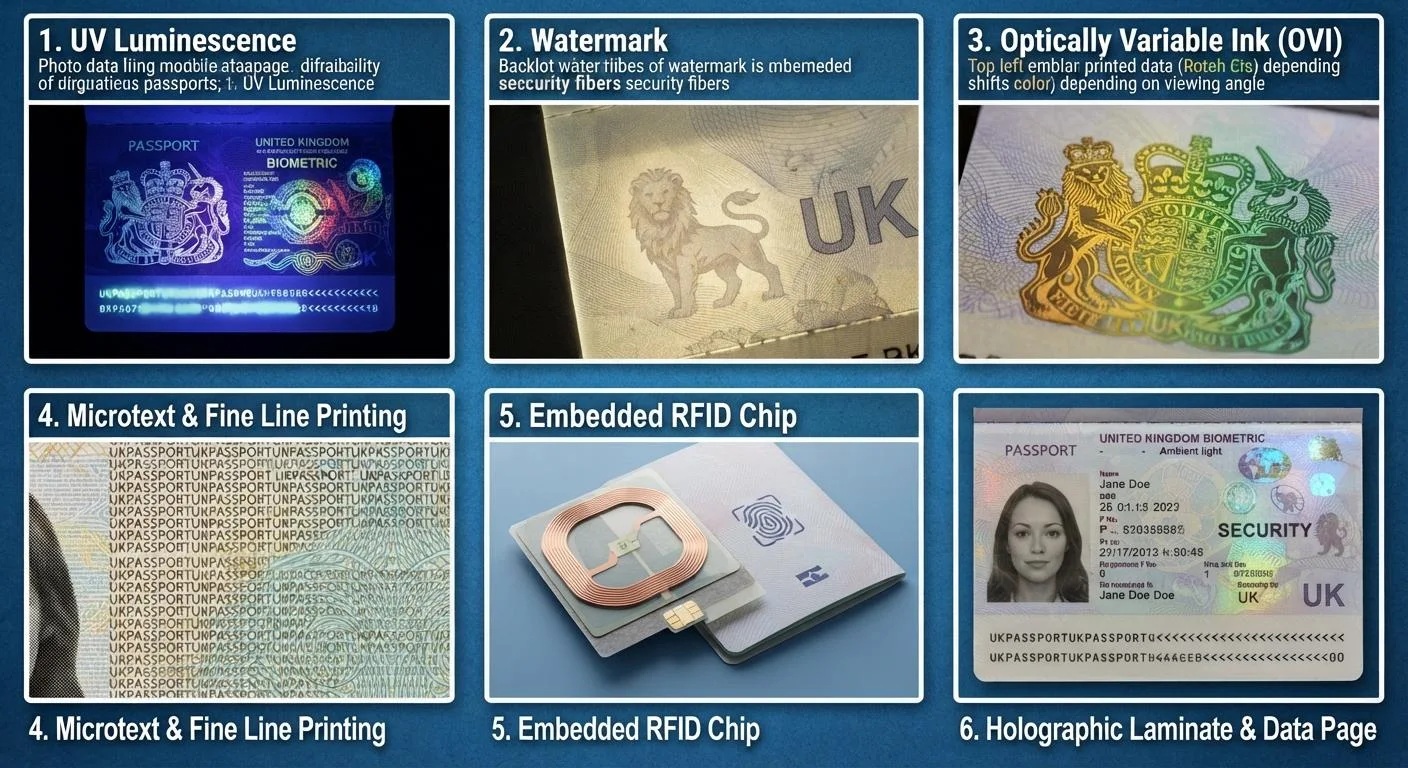
Holograms, color-shifting inks, Kinegrams, transparent structures, and other optically variable devices provide security features that change as the document moves, allowing rapid examination without relying entirely on electronic equipment or database connectivity.
A counterfeit may reproduce an optical element’s static appearance in a photograph while failing to duplicate the expected movement, depth, color transition, or viewing-angle behavior visible when an inspector physically tilts the document under appropriate lighting.
Ultraviolet Features Reveal Information Hidden in Daylight
Ultraviolet-reactive inks, fluorescent fibers, and hidden artwork provide another independent examination method because authentic passport materials can produce carefully controlled responses that ordinary paper, toner, adhesives, or commercial printing products may not reproduce accurately.
A suspicious passport that looks convincing under normal light can reveal missing patterns, unexpected fluorescence, irregular fibers, or disturbed artwork when examined under controlled ultraviolet light.
Watermarks Protect the Paper Itself
Traditional watermarks remain valuable because they are created during paper manufacture through controlled variations in fiber distribution and thickness, producing designs that become visible under transmitted light rather than existing merely as printed surface images.
This distinction makes convincing reproduction difficult because an imitation must match not only the apparent design but also the tonal depth, paper structure, and light-transmission characteristics associated with genuine security paper.
Microprinting Exposes Reproduction Errors
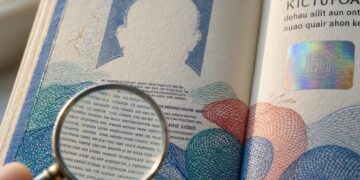
Extremely small text and intricate background lines can reveal differences invisible at a glance, especially when commercial printers, scanners, or photocopiers blur fine characters, introduce pixel structures, or distort carefully registered security patterns.
Magnification lets trained examiners assess whether line quality, registration, ink behavior, microtext, and surrounding structures match authentic production rather than merely appearing approximately correct at normal viewing distance.
Tactile Printing Adds Another Physical Test
Raised intaglio printing and other tactile features let inspectors evaluate how selected lines, letters, or symbols feel, not just how they look, creating another characteristic counterfeiters must reproduce alongside the visible artwork.
A surface that looks visually accurate but feels unexpectedly flat, glossy, irregular, or inconsistent with the known printing process can immediately prompt further examination.
Binding Protects the Passport as a Complete Booklet
Specialized stitching and controlled booklet construction help preserve page integrity because removing or replacing one sheet can disturb thread tension, puncture holes, alignment, page sequence, or neighboring components that belong to the same folded structure.
Binding security is particularly useful because a counterfeit page can reproduce printed artwork while still failing to match the mechanical relationships connecting the booklet’s pages, thread, perforations, and physical dimensions.
The Machine-Readable Zone Supports Automated Checks
The machine-readable zone provides standardized identity and document information that optical readers can capture rapidly, allowing automated systems to compare data across the printed page, electronic chip, immigration systems, and other authorized sources.
Check digits within the machine-readable information also help detect transcription or recognition errors, while inconsistencies between visible fields and machine-readable data can trigger additional inspection before authorities rely upon the document.
The Electronic Chip Adds Protected Identity Data
An electronic passport chip provides another representation of the holder’s identity, including standardized biographical information and a digital facial image that compatible inspection equipment can retrieve during authorized document checks.
The chip does not replace the physical passport, but it gives border authorities an independent electronic source they can compare with the visible data page and the traveler presenting the document.
Digital Signatures Protect Electronic Integrity
Cryptographic signatures let compatible readers assess whether protected chip information matches data originally signed by the issuing authority, making unauthorized electronic modification much harder to conceal.
The ICAO Public Key Directory supports international exchange of trusted certificate information, helping participating governments evaluate electronic passport signatures without requiring access to the private cryptographic keys used by foreign issuing authorities.
Access Controls Protect Personal Information
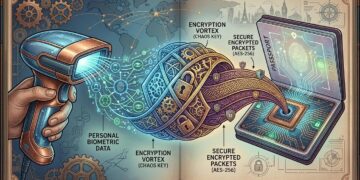
Electronic passports also use access-control mechanisms that regulate how compatible readers establish communication with the chip, reducing the risk that an unknown device within radio-frequency range could retrieve identity information.
Protocols such as Basic Access Control and Password Authenticated Connection Establishment address access and secure communication, while digital signatures separately help inspection systems verify the integrity and origin of protected electronic data.
Facial Recognition Examines the Holder Rather Than the Document
Even a genuine passport can be misused if someone other than the legitimate holder presents it, so automated gates and border officers can compare the traveler with the facial image associated with the passport.
Biometric comparison therefore addresses a different security question than electronic authentication: one evaluates whether the document data deserve trust, while the other helps determine whether the presenter matches the identity recorded in that document.
Government Databases Address Current Status
A passport can remain physically authentic and electronically intact while becoming invalid after issuance because authorities later report it lost, stolen, canceled, revoked, or otherwise unsuitable for continued travel.
Document-status and immigration systems therefore provide information that cannot be obtained merely by examining holograms, reading a chip, or comparing a face, creating another independent layer within modern border inspection.
No Single Successful Check Provides Complete Verification
A valid digital signature does not prove the physical booklet has never been altered, a correct watermark does not establish the chip remains authentic, and a strong facial match does not confirm the passport is currently valid.
Each successful result answers a narrower question, which is precisely why modern passport systems become stronger when several different examinations produce mutually consistent evidence.
Independent Features Make Fraud Harder to Conceal
Layered security makes it harder to create a convincing fraudulent document because an attacker must maintain consistency across materials, engraving, printing, optical behavior, electronic information, biometrics, booklet construction, and government records, rather than defeat one isolated safeguard.
A sophisticated imitation might reproduce a hologram convincingly but fail ultraviolet inspection, while another could include plausible electronic information but use incorrect physical materials or inconsistent machine-readable data.
Different Features Fail in Different Ways
Multiple safeguards also add value because they fail differently: physical wear may affect one feature while leaving electronic information intact, whereas a damaged chip may fail without changing the booklet’s visible authenticity.
Inspectors can therefore avoid treating one technical problem as automatic proof of fraud and instead examine whether the remaining security characteristics support or contradict the questioned feature.
Remote Photographs Cannot Show Every Layer
Photographs and scans can reveal useful visual information, but they cannot fully demonstrate tactile printing, holographic movement, transmitted-light watermarks, ultraviolet fluorescence, material structure, chip authentication, or the physical integrity of binding and page construction.
This limitation means remote document review can support preliminary assessment while remaining fundamentally different from examining the original passport through several independent physical and electronic techniques.
Security Features Are Designed to Reinforce One Another
The strongest passport designs integrate security technologies so that altering one element risks disturbing another, such as placing optical features around personalized information or connecting page perforations with the same passport number displayed elsewhere.
This integration makes successful manipulation harder because the attacker must preserve relationships among features rather than change one isolated field while leaving surrounding structures untouched.
Different Passport Generations Require Different Expectations
Governments periodically redesign their passports, so valid documents from the same country can use different materials, artwork, chips, optical devices, and printing technologies depending on the issuing period and document generation.
Inspectors therefore need reliable reference information before deciding whether a missing or unfamiliar feature indicates fraud, because applying the newest passport specifications to an older, legitimate document can lead to incorrect conclusions.
Layered Security Also Supports Efficient Border Processing
Many security features are designed for rapid first-line examination, allowing officers or automated systems to quickly identify straightforward cases while directing unusual documents to secondary inspection, where additional equipment and specialist expertise are available.
This structure lets governments balance speed and security: not every traveler needs forensic examination, but suspicious inconsistencies can trigger deeper checks when the initial evidence doesn’t align.
Human Judgment Remains Important
Automated readers, biometric systems, and cryptographic checks can process information rapidly, but trained officers remain important when technologies produce conflicting results, physical damage complicates examination, or unusual circumstances require interpretation beyond predefined automated rules.
Human review is particularly valuable because legitimate wear, aging, manufacturing variation, or technical failure can occasionally create anomalies that resemble fraud when considered without the broader context of the document and traveler.
Security Works Best When Evidence Agrees
A passport inspires the greatest confidence when its materials, printing, personalization, optical features, machine-readable information, electronic chip, digital signatures, biometric identity, and government status all remain consistent with one another.
The strength therefore comes from agreement among independent systems rather than from assuming that one sophisticated technology, however advanced, can answer every question associated with authenticity, identity, validity, and legitimate use.
Modern Passports Are Systems Rather Than Single Documents
Through Amicus International Consulting’s passport security resource, readers can examine how physical materials, optical protections, electronic chips, cryptographic safeguards, biometric comparisons, and government verification systems each contribute different forms of evidence within contemporary passport authentication.
Viewing a passport as a coordinated security system, rather than a booklet with one dominant feature, helps explain why authorities continue investing in materials science, printing technology, cryptography, biometrics, databases, and professional document examination.
Multiple Defenses Create Stronger Identity Protection
Passport security ultimately depends on more than a single feature because document fraud and identity misuse can target different weaknesses, requiring governments to protect the physical booklet, electronic information, recorded identity, and relationship between the document and its legitimate holder.
By combining independent safeguards whose strengths and weaknesses differ, modern passports create a verification environment in which successful alteration becomes harder to conceal and suspicious inconsistencies become more likely to appear somewhere during professional inspection.
The result is a travel document whose security comes not from one supposedly unbeatable technology, but from several complementary defenses that collectively make unauthorized alteration, counterfeiting, substitution, and misuse substantially more difficult to accomplish without detection.