









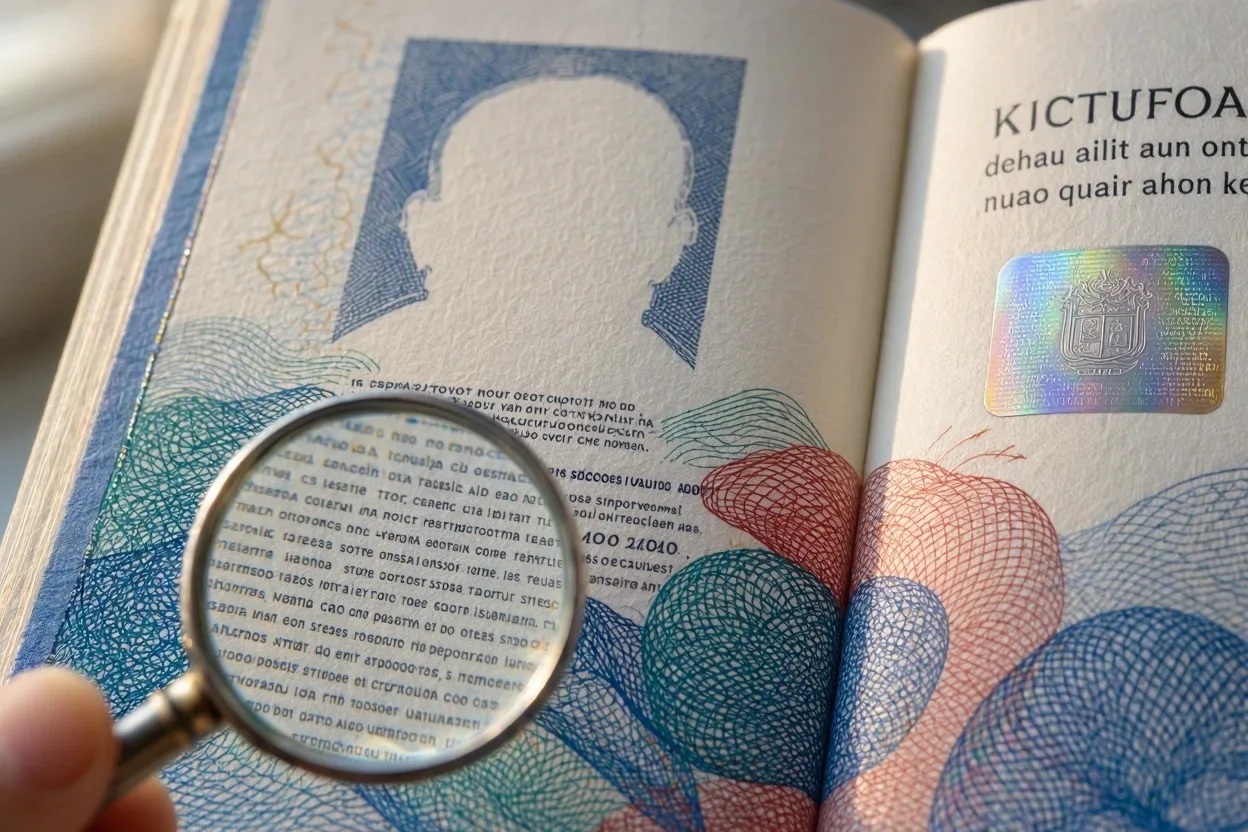
Microprinting and intricate background patterns help trained examiners identify inconsistencies in suspicious travel documents.
WASHINGTON, DC, October 12, 2026 — Some of the most useful security information in a modern passport can be smaller than the average reader can comfortably see, because governments use microprinting, fine-line backgrounds, precisely registered patterns, and specialized printing techniques that become far more revealing under magnification.
These features rarely attract as much attention as electronic chips, holograms, or biometric photographs, yet carefully engineered printing gives border officers another independent way to distinguish authentic government production from reproductions made by scanning, photocopying, conventional digital printing, or unauthorized physical alteration.
Why Very Small Printing Can Provide Strong Security
Microprinting uses extremely small letters, numbers, words, or repeating sequences that may look like a line or decorative border without magnification, but closer inspection reveals sharply formed characters intentionally built into the document’s security design.
The technique works because reproducing readable characters at extremely small sizes requires much greater printing precision than reproducing ordinary text, especially when counterfeiters rely on office printers, consumer scanners, commercial photocopiers, or lower-resolution reproduction systems.
Current International Civil Aviation Organization travel-document guidance recognizes microprinting as a technique that can strengthen secure travel documents, particularly when governments combine specialized printing with other protections designed to expose unauthorized reproduction or alteration.
Microprinting Often Looks Like a Simple Line
A legitimate passport may contain a border, portrait outline, decorative curve, background band, or apparently continuous line that, under magnification, reveals itself as a repeating sequence of tiny letters or words.
Because the feature remains unobtrusive during ordinary use, document designers can place it throughout the passport without overwhelming the visual presentation, allowing security information to coexist with national symbols, artwork, identity information, and other functional elements.
An examiner who knows what wording, character spacing, orientation, and line structure should appear can quickly identify whether an apparently correct visual feature loses definition when viewed more closely.
Poor Reproduction Can Turn Characters Into Dots
When a genuine microprinted feature is scanned and reproduced using equipment that lacks sufficient resolution, the tiny characters can lose their original shape and become blurred marks, disconnected pixels, irregular dots, or solid lines without readable internal detail.
This degradation can become obvious under magnification even when the counterfeit looks convincing at normal viewing distance, because the reproduction process may preserve overall color and placement while failing to preserve the extremely fine structures present in genuine security printing.
For trained examiners, that difference can warn that the questioned document deserves further inspection using additional physical, electronic, or governmental verification methods.
Background Patterns Serve More Than a Decorative Purpose
Passport backgrounds often contain complex networks of curved lines, geometric structures, repeating motifs, national symbols, and carefully controlled color transitions that look decorative but also make unauthorized reproduction and alteration much harder.
Security designers can create these patterns using specialist software and controlled printing processes that produce consistent line thickness, spacing, intersections, and registration across areas containing photographs, personal data, visa pages, or other important document components.
ICAO guidance advises against relying solely on widely available general-purpose graphics software when creating security backgrounds, reflecting the importance of specialist design methods in protecting travel documents from reproduction and fraudulent alteration.
Guilloche Patterns Create Complex Repeating Geometry
One common security concept is the guilloche-style pattern, where extremely fine curved lines intersect and repeat according to carefully controlled mathematical structures that can cover large portions of a passport page without interfering with readability.
A scanner may capture the general pattern but lose subtle line separations or introduce interference effects, especially when the reproduction system cannot accurately represent the original printing resolution, ink behavior, or the precise relationships among overlapping elements.
When those deviations accumulate, an examiner can discover breaks, thickened lines, distorted curves, inconsistent spacing, or other characteristics that would not normally appear in an authentic security-printed document.
Magnification Changes What an Examiner Can See
At ordinary viewing distance, a suspicious passport can look convincing because major colors, photographs, text fields, and general artwork may closely resemble a genuine specimen, while magnification reveals differences hidden within features that initially looked correct.
An examiner using a loupe, microscope, or document workstation can evaluate individual letter edges, line structures, ink boundaries, printing registration, background intersections, and microscopic details that consumer reproduction equipment may have softened or reconstructed incorrectly.
This ability to move from general appearance toward increasingly detailed examination helps authorities avoid relying on superficial similarities when determining whether a questioned passport matches an authentic government-produced model.
Printing Methods Leave Different Microscopic Characteristics
Different printing technologies create distinctive physical appearances, so inkjet, laser toner, offset printing, intaglio printing, and other processes can produce noticeably different edges, ink distribution, surface characteristics, and interactions with the document substrate under sufficient magnification.
A counterfeiter may reproduce the correct words and colors while using the wrong printing technology, creating microscopic characteristics that differ from those expected on an authentic passport issued during a particular document generation.
Professional examination therefore considers not only what information appears on the page, but also how that information was physically transferred or incorporated into the document.
Registration Can Reveal Reproduction Problems
Security printing often depends on precise registration, meaning several printed colors, fine-line structures, images, and background elements must align exactly with the original design, not just appear approximately correct.
Even slight misalignment can produce unexpected gaps, doubled edges, color displacement, broken intersections, or pattern discontinuities that become more obvious under magnification, particularly where multiple security elements intentionally meet.
These inconsistencies can provide valuable evidence because authentic production equipment operates under carefully controlled manufacturing conditions that counterfeit reproduction methods may struggle to duplicate consistently across an entire passport.
Microprinting Can Protect Personal Information
Governments can place microprinted structures near photographs, identity fields, signatures, passport numbers, or other areas that counterfeiters might target when attempting to alter a genuine document rather than manufacture an entirely false passport.
An unauthorized change to a name, date, portrait, or document number can disturb surrounding fine-line patterns, producing breaks or reconstruction marks that become apparent once an examiner compares the altered area with adjacent authentic printing.
This approach makes the background part of the protective system because changing visible information without disturbing the surrounding microscopic structures becomes much harder.
Fine Printing Can Extend Across Multiple Passport Pages
Microprinting and complex background structures are not limited to the main identity page, because governments may incorporate them into visa pages, title pages, observation pages, covers, and other sections of the passport booklet.
Using related patterns throughout the document helps authorities determine whether pages match the booklet’s expected production characteristics, especially when investigators suspect substitution, unauthorized replacement, or reconstruction.
A counterfeit page might reproduce prominent artwork but fail to match microscopic line structures, printing techniques, or recurring design features found elsewhere in the authentic passport.
Authentic Documents Can Use Multiple Printing Techniques Together
Sophisticated passports often combine several printing methods on one page, letting designers use different physical characteristics as overlapping defenses rather than relying on a single technique for complete protection.
Fine offset backgrounds, intaglio elements, laser personalization, optically variable materials, ultraviolet printing, and microtext can coexist in the same document, forcing a counterfeiter to convincingly reproduce several unrelated technologies.
The European Union’s PRADO reference system shows how authentic passports can combine microprinting with ultraviolet features, optically variable inks, watermarks, secondary facial images, and other independently examinable security elements.
Microprinting Can Be Combined With Intaglio Printing
Intaglio printing can produce distinctive raised, tactile characteristics while supporting exceptionally detailed designs, and some secure documents combine that technology with microprinting to create features that challenge both visual and physical reproduction.
A counterfeit produced through ordinary digital printing might capture the visible shape but lack the expected tactile relief, crisp microscopic characters, ink density, or surface characteristics created by the genuine security-printing process.
When multiple characteristics should appear together, inconsistencies become increasingly informative because successful imitation requires matching both visual detail and physical production behavior.
Digital Scanning Can Introduce Moiré and Pattern Distortion
Complex repeating lines can interact unpredictably with scanner resolutions and printer grids, producing interference patterns commonly known as moiré effects that were absent from the original security-printed document.
These unwanted structures can appear as waves, bands, distorted textures, or unexpected changes in line density, allowing examiners to recognize that a page may have passed through a digital capture-and-reproduction process.
Security designers can exploit this vulnerability because intricate backgrounds require reproduction systems to preserve extremely precise spatial relationships that ordinary equipment may not maintain accurately.
Photocopiers Can Preserve Shape While Losing Fine Detail
A high-quality photocopy can reproduce a passport’s overall appearance surprisingly well, especially when viewed quickly or photographed, yet microscopic inspection can reveal that fine characters and security lines have lost important structural detail.
Repeated copying usually compounds the problem because each reproduction generation can introduce additional blur, edge distortion, contrast changes, and pattern simplification that move the counterfeit progressively farther from the original manufacturing characteristics.
This is one reason document examination becomes more effective when an officer looks beyond the obvious portrait and text fields toward structures that ordinary users might never notice.
Color Relationships Can Also Be Significant
Fine-line security backgrounds often use carefully selected colors whose transitions, intersections, and registration are part of the expected document design, so an imitation must reproduce more than the approximate dominant color visible from a distance.
Commercial printers may interpret color values differently from specialized security presses, especially when unusual inks, precise mixtures, or overlapping printed elements create effects that change subtly under magnification or specialized illumination.
An examiner comparing a suspicious passport with an authentic reference specimen can therefore evaluate whether color relationships remain consistent alongside the microscopic line structures.
Microprinting Does Not Need to Be Secret
Many effective passport security features do not depend on secrecy because their protective value comes from the difficulty of reproducing their manufacturing quality rather than from preventing counterfeiters from knowing the feature exists.
A counterfeiter may know exactly what microscopic words should appear but still struggle to reproduce their character definition, registration, printing method, surrounding patterns, and interaction with the document substrate at the expected quality.
This distinction separates security design from simple hidden information, because strong features can remain publicly observable while still demanding specialized production capabilities that ordinary reproduction systems cannot provide.
Reference Documents Are Essential for Proper Examination
Inspectors must know what a genuine document should contain before concluding that an unusual microscopic feature represents fraud, particularly because passport designs change as issuing governments introduce new generations and retire older models.
A legitimate passport issued several years earlier may use different microtext, background patterns, inks, or printing technologies than a newer document from the same country, even if both remain valid for international travel.
Reliable reference resources therefore let examiners match the questioned document to the correct issuing period and passport model before interpreting apparent differences as evidence of manipulation.
Normal Wear Can Affect Fine Security Features
Passports undergo years of handling, friction, humidity, bending, inspection, and contact with luggage or protective covers, so ordinary physical wear can sometimes make authentic microprinting and fine-line structures less distinct.
An examiner should therefore consider the document’s overall condition rather than assuming one imperfect microscopic feature automatically proves counterfeiting, especially when surrounding areas show similar wear consistent with normal use.
The distinction between natural deterioration and targeted alteration becomes easier to evaluate when you examine several independent physical and electronic features together.
Photographs Cannot Fully Reproduce Microscopic Inspection
A smartphone photograph can preserve enough detail to show major passport information, but compression, focus limitations, lighting, image processing, and screen resolution can dramatically change the appearance of microprinting or very fine background patterns.
A feature that appears blurred in a JPEG may remain perfectly sharp on the physical document, while aggressive camera sharpening can sometimes make ordinary printing appear more structured than it actually looks under direct magnification.
Remote document review therefore has significant limitations when the question depends upon microscopic printing quality rather than prominent visible characteristics.
Image Enlargement Is Not the Same as Physical Magnification
Digitally enlarging a passport photograph does not create information the original camera failed to capture, so investigators cannot reliably evaluate microscopic structures by increasing an image’s displayed size.
Physical magnification of the original document allows an examiner to observe genuine printed edges, ink distribution, tactile characteristics, substrate interaction, and other details that may disappear during photographic capture or compression.
This distinction becomes especially important when someone attempts to establish authenticity using only emailed photographs rather than the original travel document.
Microprinting Complements Electronic Passport Security
Electronic passports provide cryptographic protections and digitally stored identity information, but those technologies do not eliminate the need for microscopic physical security because different fraud techniques attack different components of the document.
A functioning chip may not reveal every attempt to alter surrounding physical structures, just as perfect microprinting cannot establish whether electronic data carries a valid government signature or whether authorities subsequently canceled the passport.
Combining independent physical and electronic checks lets inspectors spot inconsistencies that might otherwise remain invisible if they relied on either category alone.
Security Printing Can Make Alteration Easier to Detect
A major objective of passport security is to make unauthorized intervention visibly disruptive, because preventing every imaginable physical attack is less realistic than designing documents that reveal evidence when someone attempts significant manipulation.
Fine background lines and microscopic text can cross or surround sensitive identity fields, so removing original information and inserting replacements requires reconstructing complex structures with exceptional precision.
Small mistakes that seem insignificant at a glance can become obvious under magnification, giving trained examiners another reason to examine the passport more closely.
Counterfeiters Must Reproduce Consistency Across the Document
Creating one convincing area does not necessarily produce a convincing passport because security printing often repeats related motifs, microtext, line structures, numbering styles, and manufacturing characteristics throughout multiple parts of the booklet.
A reproduced identity page may look acceptable on its own but conflict with authentic visa pages, booklet materials, ultraviolet patterns, or security printing elsewhere in the document.
This internal-consistency requirement substantially increases the difficulty of creating an imitation that can survive professional inspection.
Trained Examiners Look for Relationships, Not Isolated Features
Professional document examination rarely involves locating one microscopic word and declaring the passport genuine, because counterfeiters can sometimes imitate individual visible features when they know what inspectors expect.
Instead, examiners assess whether typography, microprinting, background design, color, registration, printing technique, materials, personalization, optical elements, electronic information, and booklet construction collectively correspond with the expected government document.
This broader approach makes security assessment considerably more reliable than treating any single small feature as definitive proof of authenticity.
Tiny Features Can Trigger Much Larger Investigations
A broken microscopic line, unreadable repeating phrase, incorrect background intersection, or unusual printing texture may seem minor, yet such discrepancies can provide the initial reason for moving a passport into secondary or forensic examination.
Additional inspection can then involve ultraviolet illumination, transmitted light, optical devices, electronic chip authentication, biometric comparison, database checks, or consultation with specialist document examiners familiar with the passport model.
The tiny feature doesn’t necessarily prove fraud on its own, but it can signal that other components deserve closer attention.
The Best Security Features Work Quietly
Microprinting shows that passport security doesn’t always depend on dramatic technology, because some of the most effective safeguards operate quietly within lines and patterns most travelers never consciously notice.
At Amicus International Consulting, understanding these subtle technologies helps explain why legitimate government identity documents should be assessed as complete security systems rather than judged primarily by photographs, prominent holograms, or functioning electronic chips.
A passport’s microscopic printing adds value because it gives trained examiners another independent source of evidence whose production characteristics are difficult to reproduce accurately with ordinary commercial equipment.
Small Details Strengthen the Entire Document
Microprinting and intricate background patterns strengthen passport security by forcing counterfeiters to reproduce exceptionally fine physical structures while simultaneously maintaining correct alignment, color relationships, personalization, materials, optical features, and electronic information across the document.
Through Amicus International Consulting’s international citizenship and identity advisory work, clients examining lawful travel documentation are encouraged to distinguish genuine government issuance and comprehensive verification from superficial assessments based on one visually impressive or technically functioning feature.
When trained examiners place a suspicious passport under magnification, the smallest letters and thinnest background lines can therefore become important evidence, revealing reproduction errors that remain invisible during ordinary inspection while supporting the broader process used to determine whether a travel document deserves additional scrutiny.