










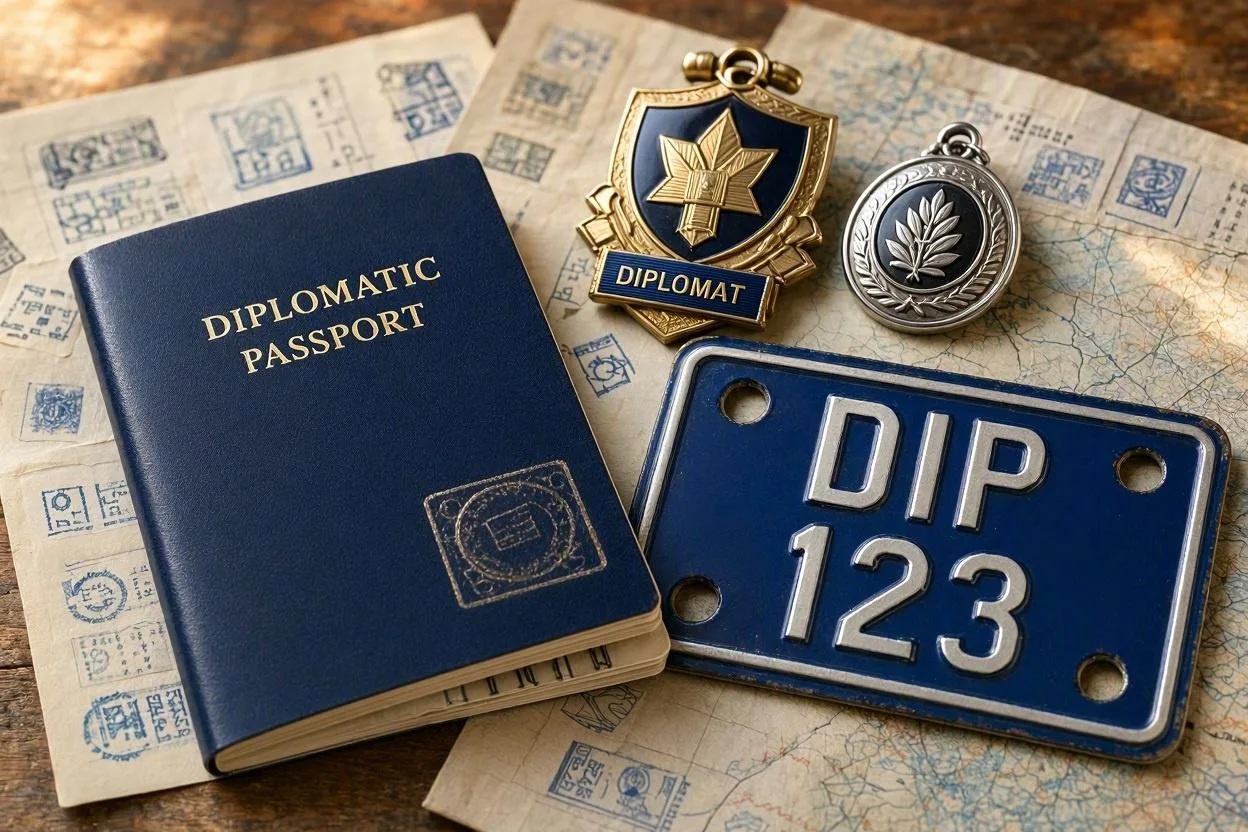
Honorary consul credentials can create an appearance of authority, but passports, badges and vehicle plaques do not independently establish diplomatic immunity, while Article 66 concerns taxation of official remuneration rather than airport privileges or protection from police enforcement.
WASHINGTON, D.C., October 10, 2026. A diplomatic passport identifies a government-issued travel document but does not establish that its holder enjoys full diplomatic immunity, a distinction central to claims that honorary consul credentials provide automatic passage through airports or protection during traffic stops.
The Vienna Convention on Consular Relations does not create a universal fast-track travel entitlement for honorary consuls, and Article 66 addresses exemption from taxation on remuneration received from the appointing government for exercising consular functions.
The concern raised by misleading credentials is therefore different from a passport-based legal exemption: an individual may claim privileges beyond those actually recognized, creating uncertainty that authorities must resolve through verification rather than appearances.
Investigative reporting has documented exaggerated immunity claims within the honorary consular system, but it does not establish that border guards or police routinely abandon enforcement whenever someone presents an official-looking passport, badge or vehicle plaque.
Article 66 Concerns Official Remuneration, Not Travel
Article 66 provides a limited tax exemption for remuneration and emoluments an honorary consular officer receives from the sending state for exercising consular functions, rather than addressing passports, immigration queues, airport screening or traffic enforcement.
That provision should not be interpreted as a general exemption for private business income, nor does its wording establish any entitlement to use diplomatic airport channels or avoid ordinary checks when traveling internationally.
The distinction matters because citing an unrelated treaty article can make a commercial promise appear legally grounded, even when the cited provision concerns an entirely different subject and supplies no support for the advertised benefit.
An accurate account of honorary consul travel must therefore begin with the relevant passport rules, the individual’s recognized status and the receiving country’s arrangements, rather than treating Article 66 as the source of travel privileges.
A Passport and Recognized Status Answer Different Questions
A passport’s official or diplomatic designation reflects the issuing government’s classification of that document, while the privileges available in another country depend on the holder’s recognized status and the applicable legal framework governing the visit or posting.
Issuance and recognition are separate decisions, meaning a government’s choice to provide a particular passport does not itself compel another government to recognize the holder as an accredited diplomatic agent with corresponding personal immunity.
Eligibility for official or diplomatic passports also varies by issuing country, so calling them a standard perk for honorary consuls requires evidence beyond isolated examples or promotional claims from appointment intermediaries.
A genuine document can therefore be paired with an inaccurate claim about its legal effect, making authenticity important but insufficient when authorities must determine whether the asserted privilege applies to the holder.
This distinction protects legitimate travelers and enforcement agencies, because misunderstanding a document’s scope can create unrealistic expectations about admission, treatment at checkpoints, or the legal consequences of conduct in another country.
Honorary Consuls Have Limited Functional Immunity
Article 58 applies Article 43’s functional immunity to honorary consular officers, protecting qualifying acts performed in the exercise of consular functions rather than providing a general exemption covering their private activities or personal travel.
That protection differs from the broader personal immunity associated with accredited diplomatic agents, and holding an honorary consular appointment does not automatically move an individual into the diplomatic category simply because a passport carries that designation.
Article 63 expressly anticipates criminal proceedings against honorary consuls and requires their appearance before competent authorities, while also addressing the respect owed to their position and the conduct of proceedings when detention becomes necessary.
The convention therefore cannot support a general promise that an honorary consul will avoid arrest, prosecution or other enforcement whenever an official credential is produced, although the applicable protection must still be assessed accurately in each situation.
Nationality, residence and any additional applicable agreements can also affect the analysis, reinforcing the need to establish the individual’s actual legal position rather than infer it from a title printed on a document.
Fast-Track Access Is Not the Same as Immunity
When an airport provides a diplomatic or official channel, the relevant arrangements and procedures govern eligibility, and using that channel alone does not establish immunity from criminal jurisdiction or exempt a person from every border requirement.
A traveler’s permission to join a particular queue, eligibility for a visa exemption, admission to the country and immunity from jurisdiction are distinct questions, even when they arise during the same journey and involve the same passport.
Expedited handling can also be an administrative courtesy, not a legally enforceable right to avoid examination or a determination that the holder has the protections of an accredited diplomat.
An honorary consul traveling outside the country that recognizes the appointment cannot safely assume that every privilege associated with that posting follows automatically, because third-country situations require their own assessment under applicable rules.
The central question is what the destination or transit country recognizes in the circumstances, not whether the traveler has previously received courteous treatment elsewhere or holds a document that appears prestigious.
Vehicle Plaques Do Not Establish the Driver’s Immunity
A vehicle displaying a foreign flag, consular emblem, or official-looking plaque may suggest a government association, but that appearance does not independently establish the driver’s identity, recognized status, or protection for particular conduct.
Article 29 addresses the use of a sending state’s flag and coat of arms, including on transport used for official business, but permission to display those symbols should not be confused with immunity from traffic enforcement.
An emblem’s lawful presence and a driver’s entitlement to a particular protection therefore remain separate questions, especially where a vehicle may be used by different people whose legal status cannot be inferred from its exterior.
Custom-made badges and privately produced plaques likewise cannot create treaty privileges, even when they resemble an official credential or the person displaying them holds a genuine honorary appointment recognized for limited consular purposes.
The distinction is between evidence that can be checked and authority that exists under law, because an impressive object may suggest a claim without establishing that the claim is accurate or currently applicable.
The United States Addressed Honorary Consul Plate Confusion
A November 2021 State Department notice on honorary consul license plates addressed the cessation of those plates; subsequent reporting highlighted the potential for consular symbols to contribute to fraud or abuse.
That historical action matters because vehicle identification can project more authority than the underlying appointment provides, giving governments a practical reason to distinguish honorary consular recognition from broader diplomatic privileges.
It should not, however, be described as proof that such plates misled every officer, or that every honorary consul displaying authorized identification attempted to evade a lawful stop or citation.
The narrower conclusion is that governments have recognized the risk of confusion associated with consular identifiers, while the legal status of an individual still requires assessment independently of the appearance of the vehicle.
What Shadow Diplomats Documented About Misleading Claims
The “Shadow Diplomats” investigation by ICIJ and ProPublica, published in November 2022, identified at least 500 current or former honorary consuls accused of wrongdoing or embroiled in controversy, encompassing different allegations, convictions and publicly documented disputes.
The reporting described consuls invoking credentials or exaggerated immunity claims to avoid searches, arrests, tax obligations, and parking fines, showing that claims of official protection can extend beyond the limited legal privileges actually available.
Those findings support examining how status can be misrepresented, but they do not establish a reliable percentage of successful attempts or justify a general claim that police officers and immigration personnel usually accept such assertions.
The investigation also described the commercial appeal of honorary appointments, illustrating why promises involving travel convenience and official status deserve scrutiny without establishing that every consultant, appointee or issuing government participates in misconduct.
Its strongest relevance to the fast-track issue is the documented gap between limited legal authority and expansive claims, rather than proof that a diplomatic passport reliably produces a particular response at a checkpoint.
An Officer’s Courtesy Does Not Establish a Legal Entitlement
If an officer chooses not to issue a citation or an airport employee provides expedited service, that outcome alone does not establish whether a treaty privilege applied, whether discretion was exercised or whether a misunderstanding occurred.
A single encounter therefore cannot support a general promise about future treatment, particularly when different jurisdictions, officials and travel circumstances may involve different procedures and different information about the person presenting the credential.
Likewise, a claim that an officer feared causing a diplomatic incident requires evidence of that encounter, not the assumption that caution or unfamiliarity explains every decision involving a foreign official or consular representative.
Responsible reporting should distinguish what a person displayed, what privilege was claimed, and what authorities actually determined, because combining those steps into a single narrative can make an unsuccessful or unverified assertion appear legally effective.
This approach also avoids portraying enforcement personnel as uniformly uninformed, while still acknowledging that specialized legal categories can create practical verification challenges and that misleading claims may exploit confusion when it occurs.
Status Verification Matters More Than Visual Appearance
The appropriate policy response to uncertainty is to reliably verify recognized status and the applicable protection, rather than unquestioningly accepting official-looking objects or automatically disregarding every person asserting a legitimate consular privilege.
In the United States, diplomatic and consular status questions involve the State Department’s recognition framework, making government confirmation more relevant than a privately produced card, a vehicle ornament or the holder’s own description of immunity.
A credential’s appearance should therefore be treated as information to assess, while the legal consequence depends on the status it accurately establishes and the rule applicable to the particular enforcement or travel question.
This distinction preserves the purpose of genuine privileges, which support international representation, while preventing a claim of prestige from being treated as a substitute for the legal conditions that governments have agreed to recognize.
A Second Passport or New Identity Does Not Create Immunity
A lawful name change or acquisition of another nationality does not create a consular appointment, and neither process alone establishes the functional immunity the convention attaches to qualifying acts performed in an official capacity.
Readers reviewing Amicus International Consulting’s information about new identity services should distinguish identity documentation from government recognition, because a commercial service description cannot establish diplomatic accreditation or determine how another country must treat a traveler.
The same distinction applies to searches about obtaining a diplomatic passport, since lawful eligibility for a document and the privileges recognized abroad require separate examination rather than an assumption that payment or possession supplies both.
For anyone facing an unresolved criminal matter, an honorary title or additional passport should not be understood as canceling the case, particularly when the convention expressly contemplates criminal proceedings against honorary consular officers.
Anonymous Travel Claims Must Reflect Legal Reality
Readers exploring Amicus International Consulting’s anonymous travel information should distinguish privacy terminology from claims of diplomatic privilege, because limiting unnecessary public exposure does not exempt lawful identity checks or immigration requirements.
A passport presented to authorities also establishes identity and travel eligibility, so the idea that a diplomatic designation itself guarantees anonymous passage is inconsistent with the purpose for which the document is examined.
Claims involving guaranteed airport access, immunity from tickets or universal protection from arrest should therefore be evaluated against the specific recognized status and governing rules, rather than the prestige suggested by a passport cover or consular emblem.
Article 66 supplies no fast-track entitlement, and the broader convention does not convert an honorary appointment into unrestricted personal immunity, leaving accurate recognition and the scope of applicable privileges as the decisive questions when official credentials are presented.